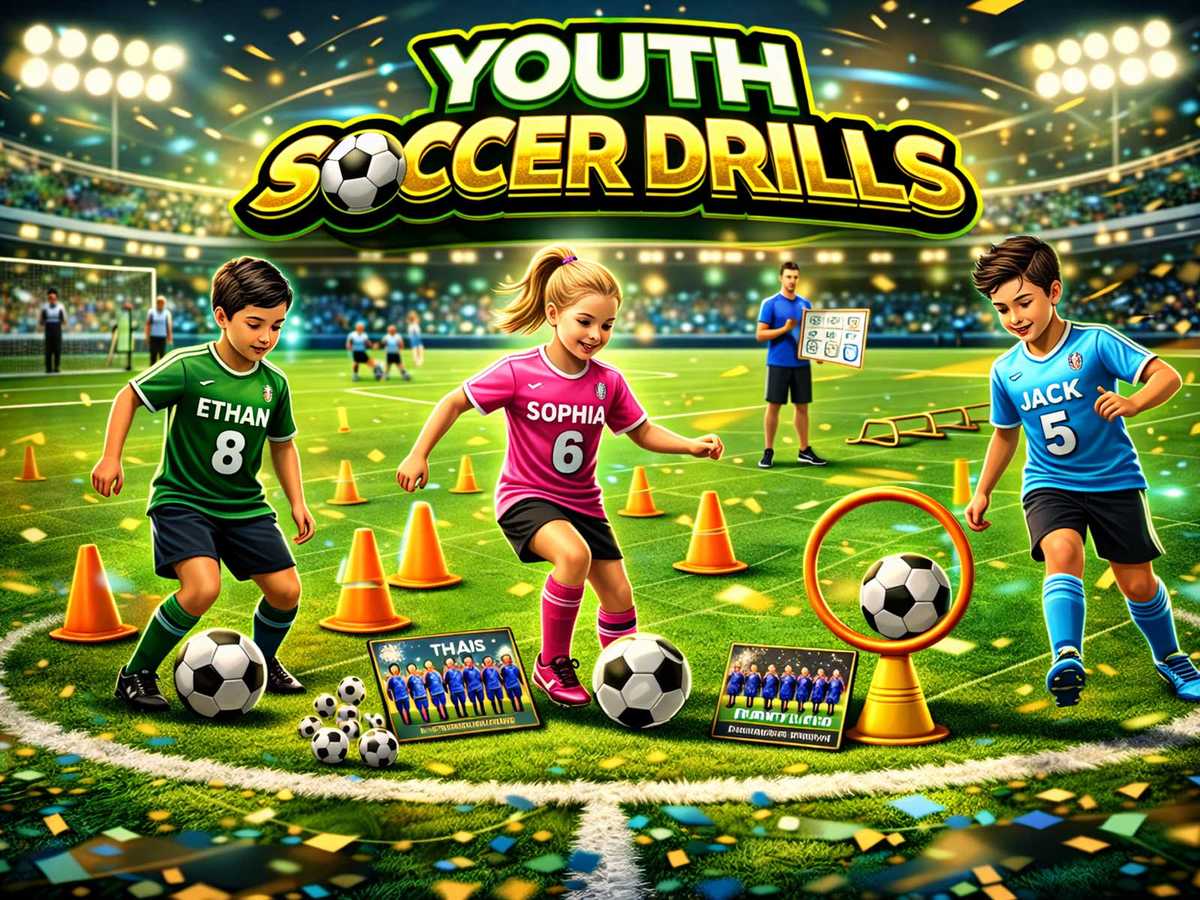
u10 drills soccer: Using 1v1 moments to build change of direction and confidence
At U10, individual duels are not just contests for the ball — they are concentrated training moments where close touches, timing and simple deception are learned under pressure. This article looks at how u10 drills soccer that centre on 1v1 situations deliberately develop change of direction (COD) and match-ready confidence in possession.
We pull together federation guidance and research-backed findings to give coaches a practical view: what these drills really train, how to structure progressions, and what to expect in terms of physical and psychological gains.
Quick answer
Federation guidance and practitioner resources recommend a progression from ball mastery to constrained 1v1 work and then small-sided games. These formats deliberately target close touches, change of pace/direction, shielding and the repeated success that builds confidence.
What you will learn here
- What 1v1 and dribbling drills actually train at U10
- Which technical cues and moves to prioritise for change of direction
- How coaches can structure progressions so practice transfers to games
Quick access
WHAT DRIBBLING AND 1V1 DRILLS REALLY TRAIN
National development frameworks put 1v1 work squarely in the Foundation Phase priorities. The Football Association (Foundation Phase 5–11) explicitly emphasises ball mastery — staying on the ball, turning, shielding and the technical execution to beat opponents 1v1 — and recommends constrained 1v1 activities as a progression. US Youth Soccer's Player Development Model (Zone 1: U6–U12) likewise lists dribbling, 1v1 attacking and defending, running with the ball and shielding as technical priorities for the U9–U10 band.
Those federation priorities are echoed in practitioner plans: provincial station sessions for the U9–U12 band (for example, a 1v1-to-goal station) list change of direction and self-confidence among intended outcomes. On the evidence side, randomized and review-level research shows small-sided formats including extreme-sided 1v1 work can produce meaningful improvements in change-of-direction performance in youth players, although methods and ages vary across studies.
u10 drills soccer: TOUCH CONTROL, SPEED CHANGE, AND DIRECTION CHANGE
Close control is the practical starting point. Coaching libraries aimed at U8–U10 recommend drills that prioritise short, controlled touches and deliberate changes of pace and direction: think cone weaves, direction-change shuttles and paired 1v1 grids that force quick decisions. Those resources routinely name simple moves such as the sole-roll, stepover and drag-push as elementary techniques to teach.
For young players the training logic is clear: small touches keep the ball playable under pressure; short bursts of acceleration after a move make the deception effective; and repeated practice in constrained spaces increases ball contacts and decision moments. Practitioner guidance therefore recommends progressing from isolated ball mastery to constrained 1v1 practice and then to small-sided games, keeping the work game-like and ball-rich.
One practical caveat from the evidence: there is no single, universally recommended "dose" (exact grid sizes, station times or repetition counts) proven for every U10 group. Coaches should follow the progression principle rather than a fixed prescription.
FEINTS, DECEPTION, AND TIMING
Feints for this age band should be simple and reliable. Across coach resources the emphasis is on body feints and compact ball manipulations that create a small opening — not elaborate skills. Moves such as the sole-roll, stepover and drag-push are repeatedly recommended because they are teachable and transfer quickly into 1v1 duels.
Timing is the under-the-hood skill: players learn to commit the defender (or read a defender's momentum) and then use a change of pace or direction to exploit the gap. Repeating these micro-situations in constrained 1v1s gives children the chance to test timing under a realistic defensive response, which both trains decision-making and provides mastery experiences that support confidence.
It is also important to be modest about claims: while coaching practice supports teaching named feints, direct randomized evidence linking a specific move to durable match-level possession gains in U10 is limited.
SHIELDING AND BALL PROTECTION
Shielding appears as a named priority in Foundation Phase guidance and in youth development documents because it is a practical response to pressure: if a player can protect the ball and turn, they both keep possession and buy time for teammates. Teaching shielding in 1v1 practice therefore combines technical touch, body positioning and balance under pressure.
Well-structured 1v1 progressions give players repeated opportunities to protect the ball, turn away from pressure and re-orient into space. Those experiences not only reinforce the technical skill but also develop coordination and the self-belief that comes from repeated success in possession, an outcome explicitly linked to confidence in applied coaching and sports-psychology literature.
HOW COACHES CAN CREATE USEFUL DUEL PRACTICE
Federation session plans and practitioner libraries share a consistent progression: start with ball mastery (isolated technical work), move to constrained 1v1 areas or paired grids, then layer the practice into small-sided games. Examples used in formal plans include paired 1v1 areas and 1v1-to-goal station work — formats designed to keep ball contact high and to force real attacking/defensive choices.
Coaching cues from these resources stress simplicity: coach close touches, encourage change of pace, teach a small palette of feints and reinforce shielding and turning. US Youth Soccer guidance adds that practice should remain game-like and include positive feedback to support learning at this age.
From a planning perspective, use short, repeatable bouts of constrained duels and then let players apply the same intent inside a small-sided game. Remember that although research supports COD and technical gains from SSGs and 1v1 work, studies vary — so vary formats and monitor how players transfer the actions into matches rather than chasing a single numeric prescription.
MATCH TRANSFER AND REAL GAME MOMENTS
Why this matters in matches: the technical and psychological targets are the same ones federations identify as priorities — staying on the ball, beating an opponent, turning and protecting possession. Systematic reviews of small-sided games conclude these formats improve tactical and technical behaviour and can affect physical outcomes; randomized youth studies have shown measurable COD gains after 1v1 SSG interventions.
From a coach's point of view, transfer looks like players who are more willing to attempt a direct move, more effective at timing a change of pace, and more able to hold possession under pressure. Those are practical indicators of successful 1v1 work and of growing on-field confidence.
CLOSING INTERPRETATION
At U10, thoughtfully organised 1v1 drills are a compact way to teach a lot: close touches, change of direction and pace, simple feints, shielding and the repeated successes that grow confidence. National frameworks and practitioner resources converge on the same progression — ball mastery, constrained 1v1, then small-sided games — and the evidence base supports COD and technical benefits from these game-like formats, even as methods in studies vary.
Practical next steps for coaches: keep the work ball-rich, teach a short list of dependable moves, use constrained duels to increase decision moments, give positive feedback and watch for better timing and greater willingness to attack. Those are the reliable signs that u10 drills soccer built the skill set and the confidence that actually transfers to matches.
Author: Alex R.