Could You Pass a Professional Soccer Fitness Test? The Honest Physical Reality
Could you pass a professional soccer fitness test? Short answer: maybe — but passing a single test is very different from coping with the physical realities of a professional match. A successful test can show capacity; surviving ninety competitive minutes with precise technique, decision-making and repeated high-intensity actions is another matter.
The obvious yes/no misses the crucial point: professional soccer combines high total distance, frequent high-intensity bursts, hundreds of accelerations and decelerations, and rapid recovery between efforts. Understanding those combined demands explains why a fitness test is only one gate in a larger selection puzzle.
The honest answer
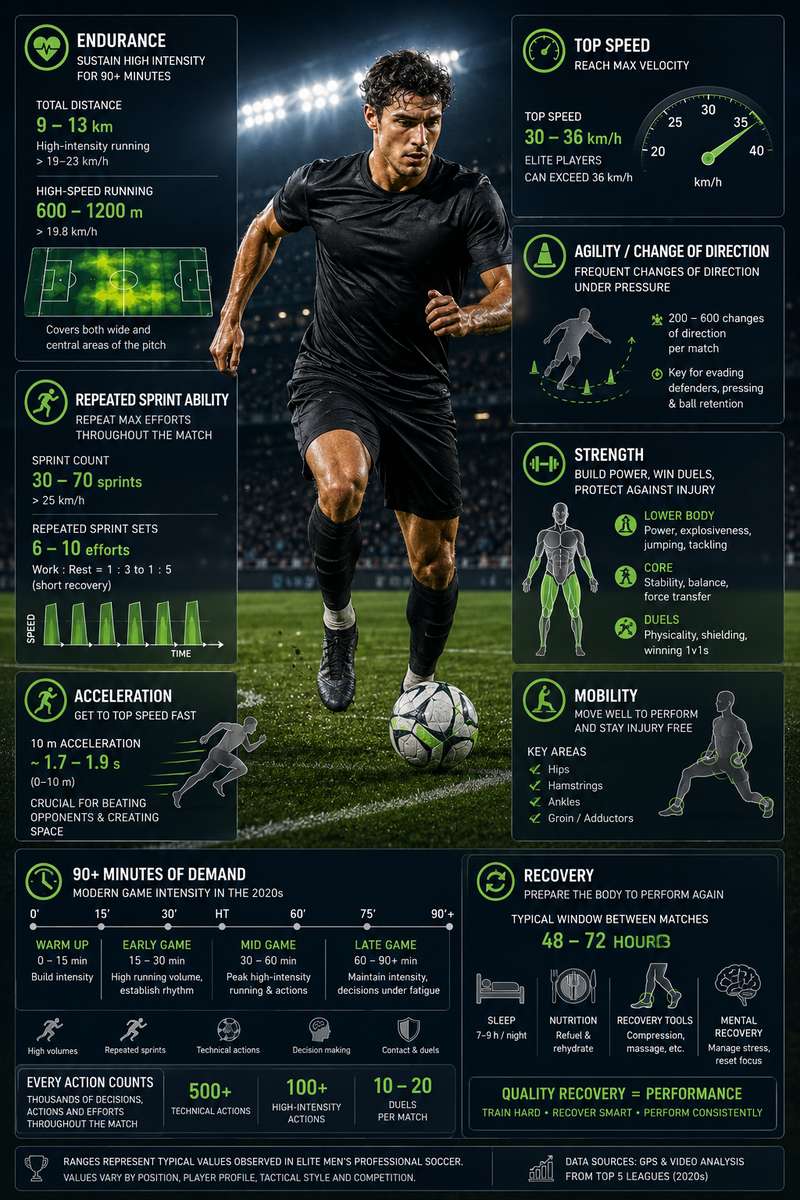
Clearing a lab or field test shows components — speed, sprint repeatability or aerobic capacity — but professional match demands are intermittent and position-dependent: players typically cover 10–13 km per match while performing hundreds of accelerations/decelerations plus decisive high-intensity runs and sprints.
What this article explains
- Which physical qualities tests usually measure and which they miss.
- How repeated-sprint ability (RSA) and accelerations shape match performance.
- Why strength, mobility and recovery planning change what a test result actually means.
What the question really means
Asking if you can "pass a professional soccer fitness test" can mean different things: completing a standard sprint or VO2 test in a lab, meeting a club's bespoke protocol, or showing match-ready durability across ninety intermittent minutes. The verified match data show that professional players typically cover 10–13 km per match and perform many accelerations and decelerations; tests that ignore that intermittent, repeated nature give an incomplete picture.
The core physical reality: distance, sprints and intermittency
Professional match play is intermittent. Total distance (commonly 10–13 km) includes mostly low-speed running, but decisive actions are high-intensity runs and sprints. High-speed running and sprint distances vary widely by competition and definition, and reported HSR ranges and sprint ranges overlap depending on methods.
Crucially, although HSR and sprinting make up a small fraction of total distance, they often determine match outcomes. Tests that only measure steady-state endurance miss how frequently players must switch into near-maximal effort with limited recovery.
Why repeated-sprint ability matters
Repeated-sprint ability (RSA) is the capacity to produce multiple near-maximal sprints with short recovery and small performance drop-off. RSA differentiates playing levels and positions and better predicts a player's ability to cope with soccer's stop-start profile than a single sprint time.
There is no single accepted RSA test: literature commonly uses 6–15 sprints over 20–40 m with short rests. Some recommendations favour protocols around 7 × 30 m with work:rest ratios near 1:4–1:5 to mirror soccer demands. Passing a one-off sprint does not guarantee you can repeat those sprints with small decrement across a match.
Acceleration, deceleration and mechanical load
Distance metrics under-represent the load of accelerations and decelerations. Players may perform hundreds of these actions in a match, and each change of velocity imposes substantial mechanical and metabolic stress. Tests that ignore repeated changes of speed miss a major source of fatigue and injury risk.
Because accelerations and decelerations are so frequent, strength and power qualities — especially eccentric capacity and horizontal force production — help players accelerate, change direction, win duels and reduce injury risk. Strength-and-conditioning programs that include eccentric and horizontal force work are linked to improvements in sprint, acceleration and change-of-direction performance.
Aerobic support and recovery between efforts
Aerobic capacity supports recovery between high-intensity actions. Higher aerobic fitness does not replace sprint power, but it helps players restore sprint performance during a match and sustain repeated high-intensity work. Therefore, a fitness test that measures VO2 or endurance contributes useful context to sprint tests, because soccer requires both sprint/power and recovery endurance.
Position and individualisation: the missing piece of many tests
Match demands differ by position. Wide players and midfielders generally accumulate more high-speed running and sprint distance than central defenders. This variation means testing and interpretation should be position-specific and, where possible, use individualized velocity thresholds rather than one-size-fits-all cutoffs.
A club's fitness test might be tailored to positional profiles; a single universal benchmark therefore says less about readiness than a position-aware assessment.
Why strength, mobility and recovery change the answer
Strength and power training — including eccentric work — translates into better acceleration, sprinting and change-of-direction. Mobility enables efficient mechanics under fatigue and in contact. Recovery strategies and careful periodization matter because soccer places concurrent demands on aerobic and anaerobic systems; poor load management can blunt acceleration and COD ability through neuromuscular fatigue or training interference.
What tests can and cannot show
Common tests reveal components: linear sprint speed, RSA under controlled rest, and aerobic markers. They are valid and reliable measures when standard protocols are used. But they cannot fully reproduce match context: decision-making under pressure, technical performance with a ball while fatigued, and hundreds of accelerations/decelerations mixed with contact and tactical constraints.
So, passing a professional-style RSA or endurance test is necessary evidence of physical capacity but not sufficient proof you can function at professional match speed while maintaining technique and tactical decisions.
How clubs use tests in context
Clubs combine test data with match GPS/monitoring and coaching observation. Tests give baseline capacity and help design strength-and-conditioning or recovery programs. Clubs also interpret tests relative to position, game demands, and periodization plans. A strong test result will inform training prescriptions but will be weighed alongside match performance and technical-tactical evaluations.
Realistic next step: what a serious player or parent should do
If your goal is to understand where you stand, use a combination of measures rather than a single test: an RSA-style protocol with repeated sprints and short recovery, a measure of aerobic capacity, and monitored accelerations/decelerations during full matches or training. Interpretation should be position-specific and linked to a targeted S&C plan that includes eccentric and horizontal force work plus mobility and recovery strategies.
Remember that tests are tools for planning and selection, not guarantees. They will tell you what to train next — not if you'll sign a contract.
Final verdict
Could you pass a professional soccer fitness test? Possibly — many trained athletes can hit isolated benchmarks. But the deeper reality is that professional soccer requires repeated sprint ability, fast accelerations and decelerations, robust strength and mobility, and aerobic support for recovery — all applied under tactical pressure across a match. Passing a test is a useful milestone; functioning repeatedly and reliably in match conditions is the real threshold clubs look for.
Author: Cynthia D.