What skills do professional soccer players need? The honest, evidence-backed…
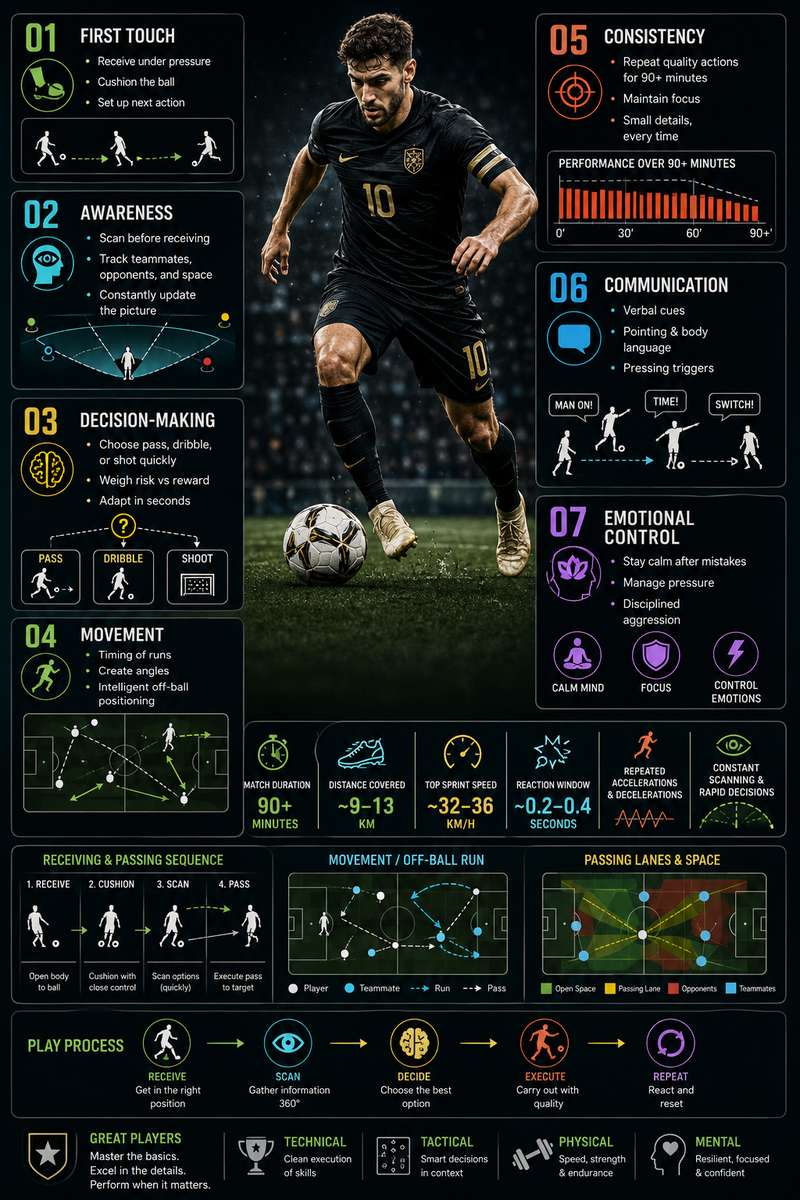
Want a straight answer? Professional soccer players need a cluster of interlinked abilities: a near-automatic first touch, constant visual awareness, fast high-quality decision-making, intelligent movement off the ball, repeatable performance, clear communication and emotional control under pressure.
That list looks simple — until you see how these qualities combine in real matches. Is a brilliant first touch enough? Not by itself. The evidence shows each ability matters most when it supports the next action and when it survives pressure, fatigue and tactical demands.
Quick answer
Top-level players combine technically reliable first touch with continuous scanning, rapid decision-making, purposeful off‑ball movement, consistent execution, active team communication and emotional regulation — each skill amplifies the others in match conditions.
What the question really means: skill versus match influence
Asking "what skills do professional soccer players need" is not only about isolated technique. Research and coaching literature show the decisive measure is match influence: does the action you perform change the next one or two seconds of play in your team's favour? A soft first touch that kills tempo is worse than a less flashy touch that puts the ball ready for a forward pass. Scouts and coaches evaluate skill in context — how reliably a player turns possession into useful options under pressure.
Core technical abilities: why first touch sits at the centre
First touch is singled out in coaching and research as a critical technical skill. Good first-touch control shapes the quality and timing of subsequent actions: it creates passing angles, protects the ball from pressure, and reduces decision time. But evidence stresses one important caveat — first touch only matters when the player's next action is correct. Technical control must be integrated with scanning and decision-making for a real advantage.
Ball mastery under pressure — receiving with correct body orientation and directing the ball into a helpful space — is what separates isolated technical proficiency from match-effective technique. Teaching and evaluation therefore focus on control that prepares the next pass, run or shot, not merely beautified trapping in a drill.
Scanning, awareness and decision-making: the perceptual core
Research links visual exploratory behaviour (scanning) to better decision-making and performance. Elite players use frequent scanning to know where teammates, opponents and space are before and during ball receipt. That pre-reception information shortens decision time and improves action quality. Studies of professional players highlight anticipation and perceptual-cognitive skills as distinguishing features at higher levels.
Decision-making itself is about choice quality under time pressure and is trainable through game-like chaotic training. Faster decisions only help when they are accurate; the evidence stresses both speed and quality. In short: seeing earlier (scanning) + interpreting patterns quickly (anticipation) = better, faster decisions.
Movement and tactical intelligence: actions without the ball
Movement off the ball — timing runs, occupying or creating space, and opening passing lanes — is repeatedly emphasised by coaches and research as essential. Movement changes what teammates can do next and how opponents must react. Tactical-technical development thus includes learning where to be, when to move, and how to create numerical or positional advantages for the team.
Good movement is visible long before a player touches the ball: it creates options and forces defenders into uncomfortable choices. That is why coaches often assess actions before possession as closely as actions after.
Consistency and what coaches actually evaluate
Coaches identify consistency — the ability to reproduce quality actions across training and full matches — as a hallmark of professional players. A single brilliant moment does not outweigh repeated poor choices. Evaluation prioritises full‑match influence, tactical fit and coachability. Players who respond well to feedback, keep performance stable under varying conditions and show repeatable decision patterns are more likely to progress.
In practice this means scouts watch for reliable behaviours: scanning frequency, first touch under pressure, movement that creates options, recovery runs, and how a player behaves after mistakes. These repeatable patterns are stronger predictors of selection than sporadic highlight-reel plays.
Communication and emotional control: the quieter but decisive skills
Verbal and non-verbal communication supports defensive organisation, passing networks and team coordination. Empirical studies tie intra-team communication to positional roles and passing behaviour — a player who organises teammates or gives timely cues increases collective effectiveness.
Emotional regulation (resilience, attentional control, self-talk) is backed by intervention research as improving decision-making under stress. Psychological skills training can reduce performance drops caused by pressure and fatigue, helping technical and perceptual abilities remain effective late in matches or after mistakes.
Hidden constraints and common misconceptions
Two common errors appear in development thinking. First: treating isolated drills as equivalent to match performance. Completing a control drill perfectly does not guarantee the same touch or decision under a defender’s pressure and after repeated sprints. Second: overvaluing single-attribute talent. Top players combine technical reliability with perception, movement and psychological control. Research shows perceptual-cognitive skills and the ability to perform under realistic, chaotic conditions are crucial.
Therefore, training and evaluation must be contextual and game-like: you need repeated practice of technical actions while scanning, moving and making decisions under pressure to create match-transferrable skill.
Translating skills into realistic progression and visibility
Because scouts and coaches emphasise match-effective behaviours, players should prioritise environments that test integrated skills: competitive full matches, small-sided games that force scanning and decision speed, and training that replicates pressure and fatigue. Demonstrating repeatability across whole games matters more than isolated success in friendlies or training drills.
For visibility, evidence suggests coaches look for behaviors that indicate sustainable match influence: frequent scanning, consistent first-touch under pressure, purposeful movement, and steadiness in decisions. Showing these qualities across competitive matches — not only in highlights — is how players make credible progress.
Final verdict: can you become the kind of player scouts want?
The honest, evidence-based verdict is balanced: the essential skills are clear and trainable — especially first touch, scanning, decision-making, movement, communication and emotional control — but they must be learned and demonstrated together in match-like contexts. Isolated talent helps, but coaches and research show that perceptual-cognitive integration, repeatability and psychological regulation decide who functions reliably at the professional level.
If you want to know what matters most today: practise technical control under pressure, make scanning and movement habitual, work on decision-making in chaotic drills, and build emotional routines that protect your focus. Then show those behaviours consistently across full matches — that's the evidence-backed path that actually attracts coaches and scouts.
Author: Cynthia D.