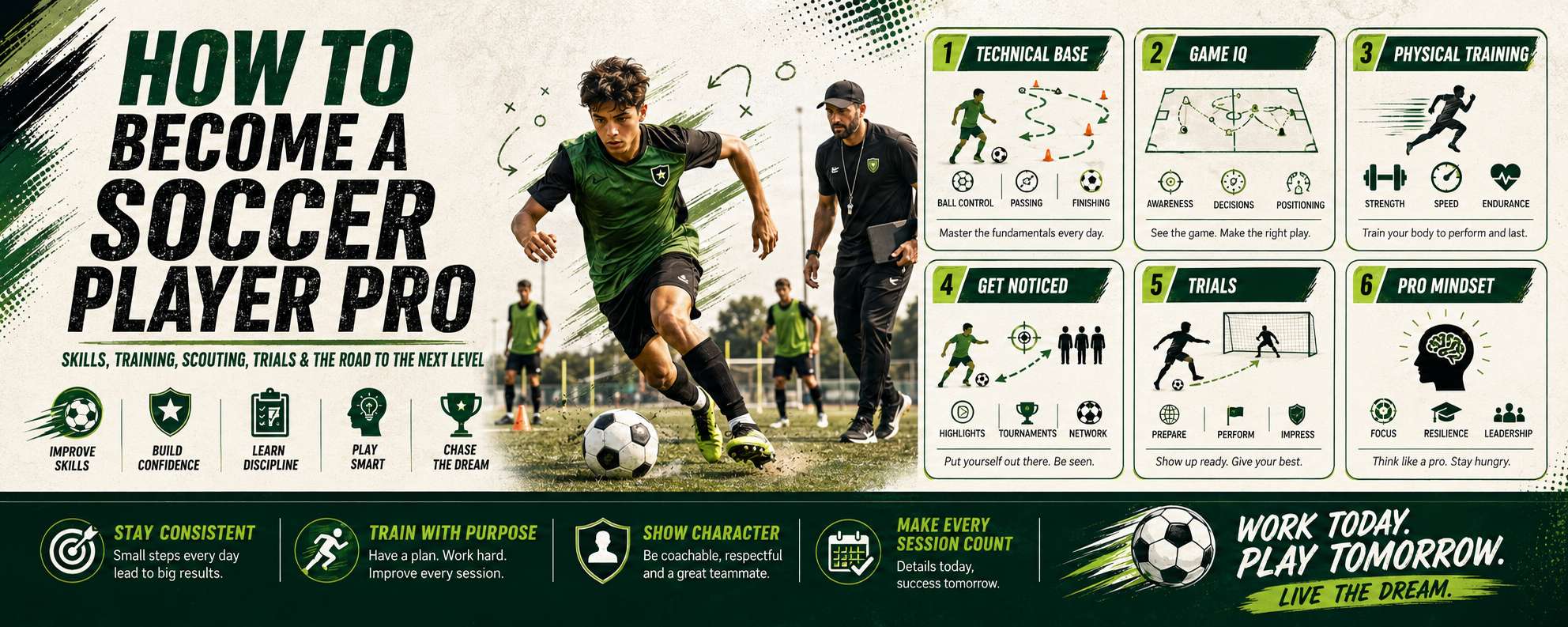
Do You Have What It Takes to Be a Professional Soccer Player?
Yes — but not by a single test or a highlight reel. Becoming a professional soccer player is multidimensional: technical skill, tactical intelligence, physical attributes and psychological traits must combine over time, and selection systems often reward early maturity and consistent match influence.
That short answer leaves out the real mechanisms and constraints that decide which players progress. Below we unpack what scouts and researchers actually measure, what can be trained, what is harder to change, and how realistic pathways look for most players.
Quick answer
Professional-level performance requires a multi-year, multi-factor progression. Technical and tactical quality are essential but not sufficient: physical benchmarks and psychological characteristics matter too, and no single metric reliably predicts pro status.
What this article explains
- Which abilities matter and how they interact.
- What talent-identification research reveals about selection biases.
- Which qualities are most trainable and which depend on long-term development.
- A realistic view of pathways and where careers typically narrow.
What does the question really mean?
Asking “do you have what it takes?” implies a single threshold. Research shows there is no universal cutoff. Governing bodies and talent-identification studies treat professional potential as the product of multiple domains — technical, tactical, physical and psychological — observed over time rather than judged in isolation.
So the real question becomes: does your profile show the combination and trajectory that selectors expect? That requires consistent match influence, measurable physical capacity relative to the cohort, clear tactical understanding, and psychological traits that support development.
The deep reality behind the “yes, but”
Systematic reviews and federation guidance emphasise a multidimensional approach. Individual tests (sprints, jumps, ball drills) capture parts of the picture, but research warns that no single metric reliably predicts future professional status. Longitudinal monitoring — tracking players across seasons and contexts — gives far better insight than one-off trials.
Selection processes also interact with context: age-group structures and biological maturation affect test results. Early-maturing players often show superior physical test scores for their age and therefore are frequently overrepresented in selection, creating a bias against later developers.
Core abilities that matter
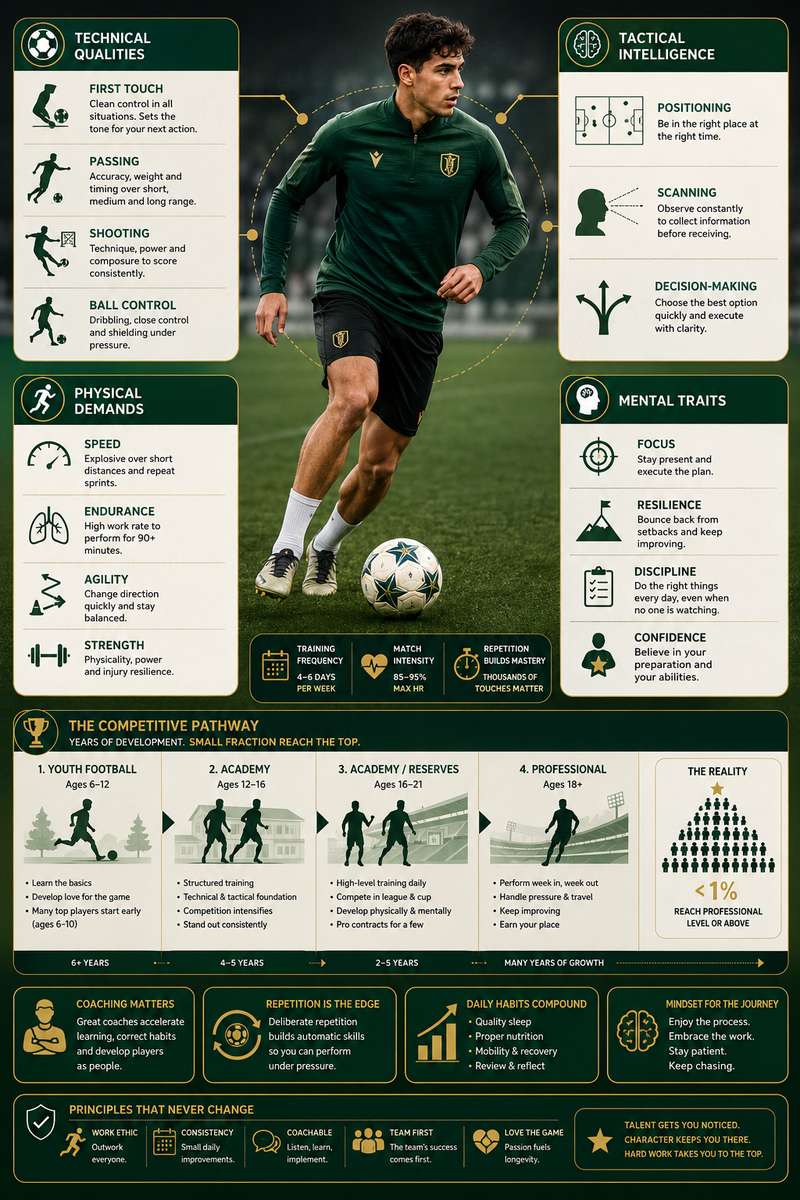
Research and talent frameworks group the decisive qualities into four domains. Each matters differently depending on age, position and club philosophy.
Technical and tactical — Ball control, first touch under pressure, passing accuracy in context, receiving while scanning, decision-making and game awareness are consistently linked to selection outcomes. However, technical tests alone do not tell the whole story: selectors look for how often a player makes the right decision at match speed and how their actions influence the team.
Physical — Elite players typically demonstrate higher aerobic capacity, stronger repeated-sprint ability, superior sprint and jump performance, and lower body-fat profiles than non-elite peers. These physical benchmarks are part of what separates professional performers in studies, but they vary by position, sex and age group.
Psychological — Traits such as resilience, self-regulation, sustained motivation and commitment are associated with progression. Meta-analyses find these characteristics explain variance in development beyond practice alone; they support recovery from setbacks and consistent improvement.
Maturation and context — Biological age affects physical testing and selection. Early physical developers can look superior before later developers catch up technically and tactically. Club philosophy, coaching quality, match exposure and logistics (location, travel) also shape opportunities.
What can be trained — and what is harder to change?
Talent-identification research and practical talent-development guidance point to a mix of trainable and less-malleable factors.
- Trainable over months–years: ball control under pressure, decision-making habits, scanning routine, technical weak-foot improvements, tactical understanding, aerobic endurance, repeated-sprint conditioning, and many psychological skills when coached (goal-setting, self-regulation, resilience training).
- Develops with maturation and time: peak sprint power, jump performance, and some strength and body composition markers shift with biological maturation and long-term conditioning.
- Less predictable or slower to change: innate reaction time range, natural recovery profile, and the timing of maturation. These can be compensated for by superior tactical sense or technical repeatability, but they influence the speed at which a player reaches parity with elite peers.
Importantly, research recommends broad exposure and quality coaching to maximise late developers' chances. The pathway that lets a player play, be coached well, and be monitored over seasons increases the chance that trainable qualities emerge.
How scouts and researchers evaluate players
Studies show evaluators consider multiple signals, not only highlights. They value consistent decision quality, actions before the ball arrives (movement and scanning), first touch under pressure, tactical fit, and psychological profile. Physical test scores are used as one input among many.
Because no single metric predicts future status, talent ID frameworks recommend longitudinal assessment: repeated observations in matches and training over months and years to see whether improvements stick under pressure and fatigue.
Common misconceptions and hidden barriers
Misconception: an isolated technical skill or great trial performance guarantees progression. Reality: selection favours players who influence full matches consistently and fit a club’s tactical model.
Hidden barriers include selection bias toward early maturers, limited roster spots, inconsistent coaching, injuries, and unequal access to quality training and competitive matches. Financial or geographic limitations can reduce visibility even for talented players.
Realistic pathways — and where careers usually narrow
Research-backed advice emphasises broad competitive exposure plus quality, longitudinal coaching. Pathways typically combine grassroots club competition, higher-level youth teams or academies, and steady monitoring. Where progression narrows is predictable: when teams move from large youth pools to smaller elite squads, selectors prioritise players who already combine technical reliability, physical readiness for the cohort, tactical fit, and resilient psychology.
For late developers, the recommended strategy in the literature is sustained match play, targeted physical conditioning timed to maturation, and psychological support. This combination gives selectors evidence that improvements are robust, not temporary.
Final verdict
Could an ordinary player become a professional? Yes — under the condition that multiple, interacting qualities align over time and are visible to decision-makers. But there is no single pass/fail test. Research shows that selection is best predicted by longitudinal, multi-domain evidence: consistent technical performance at match speed, adequate physical capacity for the cohort, clear tactical intelligence, and psychological traits that sustain development.
If you care about a professional pathway, treat the goal as building a profile across these domains and getting long-term exposure in quality competition. That is the evidence-based route that gives late developers and ordinary players the best chance to close the gap.
Author: Cynthia D.