Are soccer players born talented or trained? What research really says
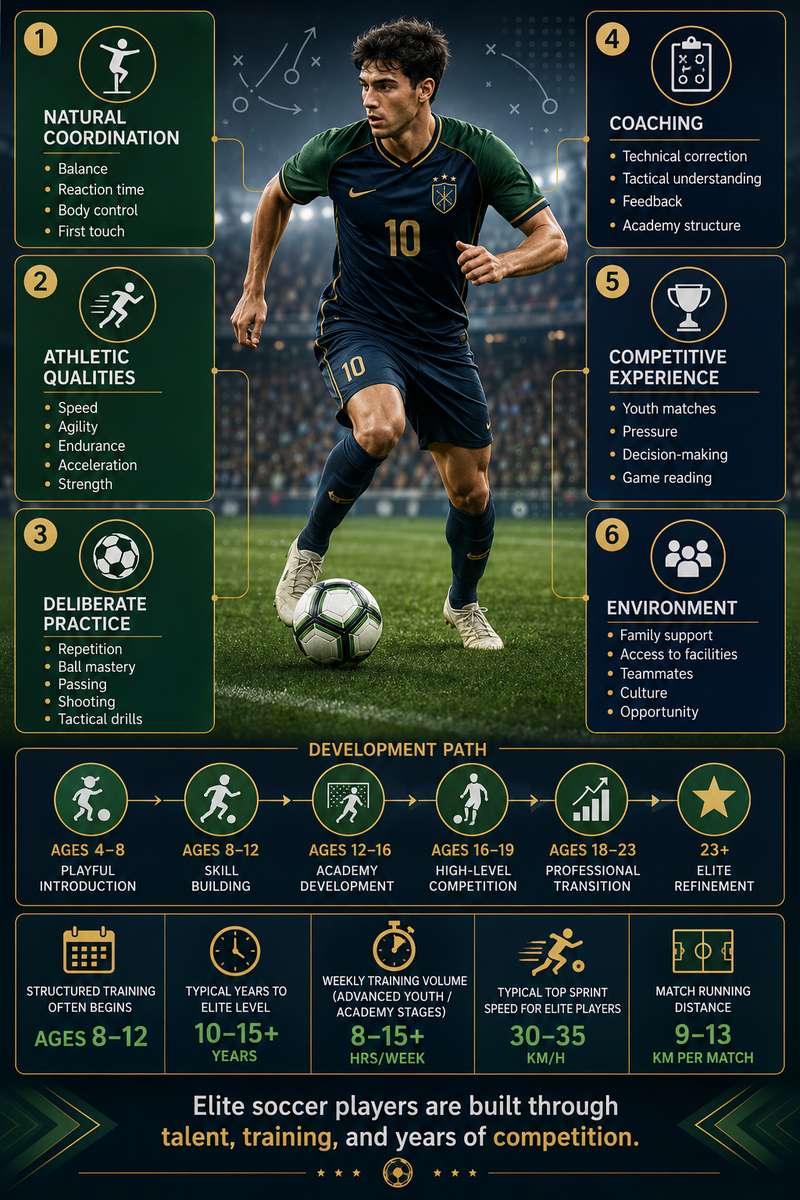
Short answer: neither pure birthright nor practice-alone explains who reaches elite soccer. Research shows elite performance emerges from multiple interacting factors — early motor coordination and physical traits, long-term deliberate practice, coaching quality, competitive experience and the environment that shapes selection.
That answer is useful but incomplete: saying "both" hides how selection, maturation and context tilt the ladder. Below I unpack what the studies actually find, what scouts and programmes should notice, where development systems commonly fail players, and what a realistic pathway looks like.
The honest answer
Multiple, interacting influences create elite soccer players: innate coordination and physical qualities give an early advantage, but high-quality, task-specific practice, coaching and supportive environments are central to converting that potential into elite performance.
What this article explains
- Why multifactor models replace single-factor 'born vs trained' myths.
- Which early traits predict later soccer skill, and which depend on training.
- How structural biases like maturity and relative age affect who gets chances.
- What coaching and environment actually add beyond extra hours with the ball.
- A realistic development perspective for players, parents and coaches.
What the question really means
"Born talented or trained" is shorthand for two separate claims: first, that stable, innate traits alone explain elite performance; second, that practice alone can produce elite players regardless of starting point. Systematic reviews and contemporary research reject both extremes. Instead, they recommend multifactor approaches that assess physical, technical, psychological and environmental contributors over time rather than relying on one-off selection.
The early direct answer — yes, but context decides
Evidence shows general motor coordination in childhood predicts meaningful variance in later soccer-specific technical and physical outcomes. At the same time, deliberate, task-specific practice and long-term training are central to skill acquisition. Neither factor alone guarantees elite status: coordination gives an early advantage that practice amplifies, while coaching and the competitive environment shape whether that advantage turns into a career.
Core abilities: what is more innate and what is trained?
Research highlights a few consistent distinctions. General motor coordination and fundamental movement skills appear early and predict later technical outcomes; they are partly innate and partly shaped by early movement experiences. Deliberate practice — structured, task-specific training with feedback — is necessary for refining first touch, passing at match speed, and role-specific techniques, but practice without quality coaching and varied match exposure reaches a ceiling.
- Innate-leaning factors: baseline motor coordination and movement control that make early technical learning faster.
- Trainable but time-dependent factors: ball mastery under pressure, scanning habits, decision speed and positional intelligence through deliberate practice and match play.
- Environment-dependent factors: coaching quality, access to competitive matches, and an organised development pathway that provide the conditions for practice to be effective.
Scanning, decisions and match intelligence — where practice matters most
Technical skill in isolation (juggling, passing drills) is not the same as match-effective skill. The literature emphasises that decision-making, anticipation and movement without the ball are shaped by long-term exposure to representative match conditions and feedback from experienced coaches. High-quality practice designs that replicate game constraints accelerate the conversion of technical ability into match influence.
Physical demands, positional profiles and maturity biases
Talent research also shows physiological and positional demands differ. Contemporary studies point out that what counts as desirable physical qualities varies by role — endurance and repeated high-intensity actions for some positions, different speed profiles for others. Importantly, maturity-related selection biases and the Relative Age Effect skew youth pathways: players born earlier in the selection year or who mature earlier are over-represented, demonstrating that selection systems can mistake temporary physical advantage for long-term talent.
What coaches and scouts actually evaluate
Systematic reviews find talent identification historically overstressed single markers. Modern practice emphasises full-match influence, consistent decision quality, coachability and adaptability. Coaches and high-performance programmes now recommend longitudinal evaluation and individualised development plans rather than one-off selection events. This shifts attention from isolated technical feats toward repeatable performance under game pressure and the player's response to coaching.
Pathway reality: why environment and coaching matter more than extra hours alone
Deliberate practice is effective only when designed and supported. Governing bodies and high-performance programmes stress coaching quality, clear coaching philosophies and training designs that match match-demands. A player who trains many hours without reflective feedback, representative drills or progressively challenging competition will improve less than one with fewer hours but better coaching and environment.
Research encourages a move from talent identification to talent development: systems that track players longitudinally, adapt to maturation timing and provide diverse match experiences produce better long-term outcomes than those that select and deselect early without follow-up.
Hidden constraints and common misconceptions
Three frequent misreadings arise when people ask whether players are born or trained:
- Misreading 1: Early superiority equals permanent talent. Maturation and relative-age biases can make a physically mature child look superior; long-term projection is much harder.
- Misreading 2: Quantity of practice equals elite outcome. Studies emphasise task-specific, high-quality practice with coaching — not hours alone.
- Misreading 3: One trait predicts success. Reviews show multi-dimensional models (physical, technical, psychological, environmental) outperform single-factor explanations.
Realistic next steps for players, parents and coaches
If you are aiming to progress, the evidence supports three practical priorities: cultivate broad motor skills early, seek coaching that uses representative, game-like training, and find competitive match exposure that challenges decision-making under pressure. Systems that monitor development over time and adapt training to maturation are more likely to spot late improvers and protect young players from premature deselection.
That does not guarantee a professional career — pathways differ by country and context — but it aligns effort with what research shows actually develops match-effective players.
Final verdict
Are soccer players born talented or trained? The correct framing is that elite players emerge from an interplay of early coordination and physical traits, long-term deliberate practice, high-quality coaching, and supportive development environments — all viewed longitudinally. Policy and practice should avoid binary thinking: build systems that recognise early advantages without freezing selection, provide high-quality coaching, and value longitudinal development so that both early and late developers can be accurately assessed.
Author: Alex R.