Red Card Soccer Explained: What a Sending-Off Means and How Teams Adjust
A red card—also called a sending-off—is one of the clearest and most consequential events in a soccer match. This article explains what a red card means, the common reasons a player can be sent off, how a team adapts tactically when it must play a player short, and why discipline often decides matches.
Quick summary: A red card requires the sent-off player to leave the field and its immediate surroundings and they cannot be replaced; teams must finish the match with fewer players, which forces tactical and strategic changes.
Quick access: What is a red card • Common offences • Playing short-handed
What a red card means
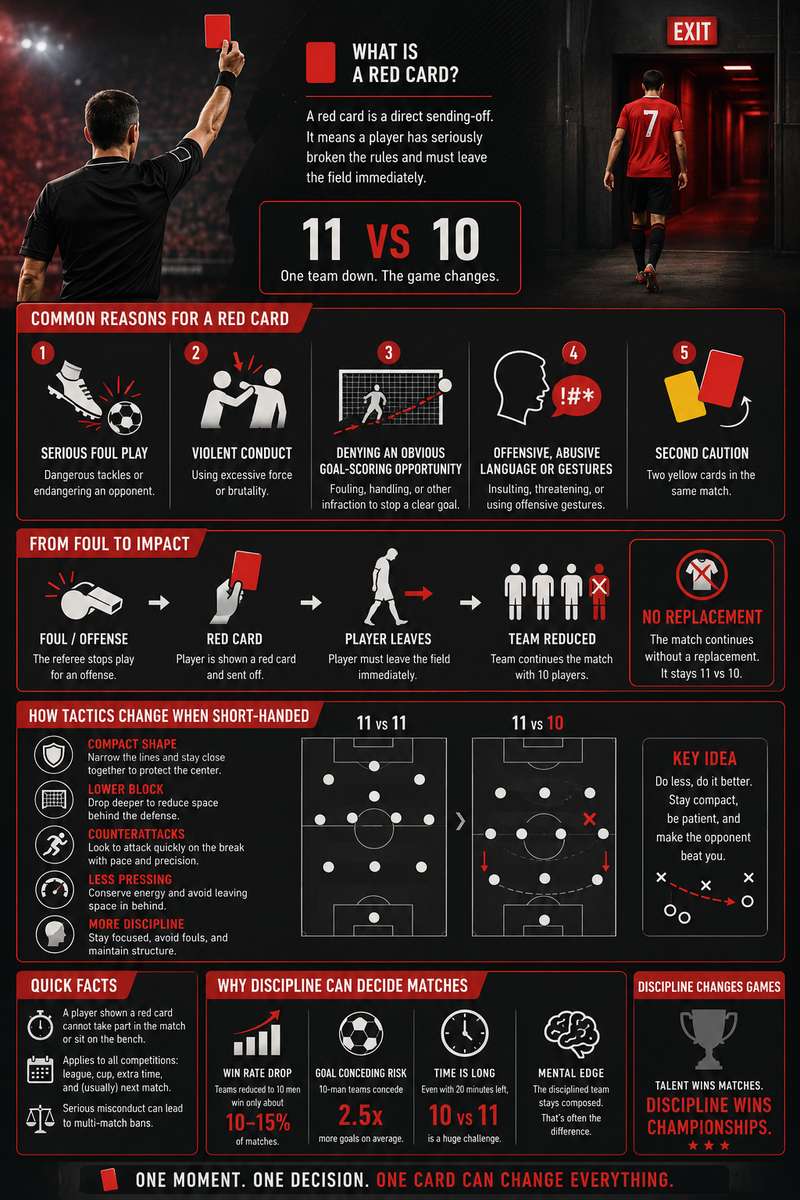
In soccer a red card is the referee’s signal for a sending-off: the player, substitute, or team official who is sent off must leave the field of play and its immediate surroundings and cannot be replaced for the remainder of the match. That reduction in numbers is immediate and permanent for that match, so a team continues with one fewer player on the pitch.
Common sending-off offences
Law 12 lists the typical reasons for a sending-off. These include serious foul play, violent conduct, denying an obvious goalscoring opportunity (often abbreviated DOGSO) by committing a foul, using offensive or abusive language, and receiving a second caution (two yellow cards) in the same match. When a player is shown a second yellow, the match record will show two cautions followed by a sending-off; more serious incidents can receive a straight red.
The referee may also apply advantage if play continues after an offence, but if the advantage does not materialize the referee can return to issue the appropriate sanction at the next stoppage. In competitions that use VAR, video review can lead to a red card being given or overturned under competition protocols, for example to correct mistaken identity or to catch serious missed incidents.
Immediate match and disciplinary consequences
The immediate consequence is numerical: the sent-off team plays with one fewer player and cannot replace that player for the rest of the match. Beyond the in-game effect, competition or association disciplinary rules determine post-match sanctions. A sending-off typically triggers at least an automatic suspension pending review, and the length of any suspension or additional fines depends on the nature of the offence and the competition’s rules.
How playing short-handed changes tactics
When a team is reduced to 10 players it commonly must alter formation and tactics to protect space and limit vulnerability. Typical adjustments include becoming more compact—narrowing the defensive block to protect central areas—sacrificing an attacking player (for example a forward or winger) to add defensive cover, or shifting personnel to preserve balance. Teams often concede more possession, press selectively rather than constantly, and rely on counterattacks or set-piece opportunities rather than sustained attacking play.
Tactical choices after a red card depend on match context: scoreline, minutes remaining, and the team’s strengths. Coaches may opt to protect the defensive shape and hope to regain a point, or reorganize to preserve attacking threat while covering key zones like the penalty area and the channels.
Why discipline can decide matches
A red card often has a decisive impact because losing a player reduces a team’s capacity to control possession, cover space, and maintain attacking options. Statistically and anecdotally, teams with a sending-off are at a disadvantage and results frequently change after a red card. That said, teams can still draw or win while a man down when they adapt tactically and defend with concentration.
Coaching, youth soccer and training takeaways
In youth development coaches emphasize discipline, decision-making, and timing of tackles to reduce the risk of sending-offs. Drills that teach safe tackling technique, positioning to avoid desperation fouls, and situational awareness near the penalty area help players make better choices. Because youth formats vary, coaches should also explain competition-specific consequences for red cards in their league.
Team culture, recognition and soccer visual language
Discipline is part of team culture: coaches and captains set expectations about aggressive play, respect, and emotional control. For teams marking season milestones—senior night, awards, or player recognition—custom soccer posters and wall art can reinforce positive values like leadership, composure, and commitment to the team. Celebrating players who model discipline and smart decision-making can be as meaningful as recognizing goals or assists.
What viewers and parents should watch for
From the sideline or on TV, watch how the sent-off team shifts shape: narrower lines, a withdrawn fullback, or a forward replaced by a midfielder are common visual cues. Also note how the opponents exploit extra space—more width in attack or overloads in midfield often follow a red card. When VAR is in use, expect pauses and reviews for serious incidents; these can change what the referee decides after play restarts.
Closing interpretation
A red card is simple to describe but complex in effect: it removes a player immediately and forces teams to rethink tactics, protect space, and manage the remaining minutes with fewer resources. For players and youth teams the lesson is clear—discipline and sound decision-making matter on and off the ball. For fans and families, understanding the rule helps make sense of momentum swings and managerial adjustments. For teams preserving season memories or recognizing players, visual reminders like custom posters can celebrate the quieter virtues—leadership, composure, and teamwork—that reduce the risk of costly sendings-off.
Author: William L.