Yellow Card in Soccer Explained: What a Caution Means and Why It Matters
A yellow card — officially called a "caution" under the Laws of the Game — is the referee's formal signal that a player, substitute, or substituted player has been disciplined for misconduct. Understanding what a yellow card means helps beginners, parents, and fans follow match decisions, helps coaches manage player behavior, and helps teams turn moments into meaningful recognition or learning opportunities.
Quick summary: A yellow card is a caution for misconduct listed in IFAB's Law 12. Two cautions in one match equal a sending-off. Competitions may apply accumulation rules across matches that lead to suspensions.
Quick access: Definition • How it works • Rules & refereeing
CLEAR DEFINITION
A yellow card, or caution, is the disciplinary sanction a referee shows to indicate a player, substitute, or substituted player has been cautioned for misconduct under the Laws of the Game. It is a formal warning recorded by match officials and reported after the game.
HOW IT WORKS
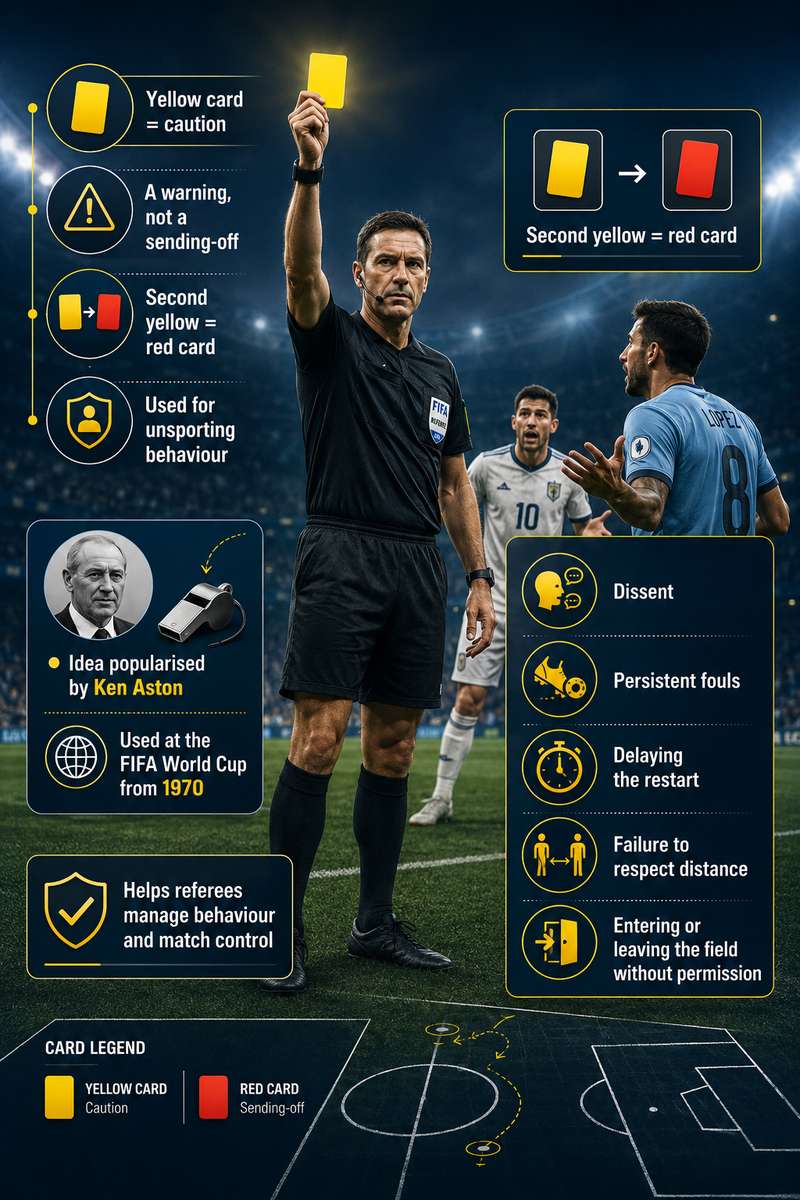
IFAB's Law 12 lists specific cautionable offences. Examples include unsporting behaviour, dissent by word or action, persistent infringement of the Laws, delaying the restart of play, failing to respect required distance at restarts, and entering or leaving the field without permission. When the referee judges one of these offences has occurred, they show the yellow card to the offending player.
The yellow card serves two main on-field functions: it penalizes the immediate misconduct and signals to the player (and teammates) that further misconduct will have stiffer consequences. The referee applies the Laws to keep the match fair and safe and to maintain control "in the spirit of the game."
RULES AND REFEREEING
Under the Laws, a player who receives a second yellow card in the same match is sent off and shown a red card; that player must leave the field and take no further part in the match. Referees record cautions and sendings-off in the match report.
Competition organisers set additional rules about yellow-card accumulation across matches. When a player reaches a specified number of cautions across different matches, the competition's regulations often impose a suspension. The exact thresholds and when card counts reset are defined by each competition (for example, by FIFA, UEFA, or domestic leagues).
IFAB and governing bodies also issue guidance and circulars clarifying application of the Laws. In some competitions or trials, temporary dismissals ("sin bins") have been used for certain offences; where implemented, guidance specifies how referees indicate and manage temporary dismissals in relation to yellow-card procedures.
WHY IT MATTERS IN SOCCER
Cautions matter because they influence match behaviour, coaching decisions, and player availability. A player on a yellow card is under greater pressure to avoid reckless challenges or dissent, since a second caution means dismissal. Teams must manage tactics and substitutions when a player with a booking risks being sent off.
Across a season or tournament, accumulated cautions can lead to suspension under competition rules, so coaches track bookings to protect key players from missing important matches due to accumulation.
POSITIONS, PLAYER ROLES & TACTICAL IMPACT
Different positions face different booking risks. Defenders and defensive midfielders often confront situations—tackles, last-ditch interceptions, persistent pressures—where cautions are more likely. When a defender is booked, a coach may change defensive shape, substitute to protect a player from a second yellow, or instruct teammates to provide cover to avoid risky challenges.
On the tactical level, a team playing with a player reduced to ten after a sending-off must reorganize spacing, pressing, and transitions. Conversely, a team with a cautioned opponent can adjust attacking patterns to target the booked player's area, knowing that forcing that player into repeated fouls may yield a second yellow and a sending-off.
TRAINING AND YOUTH DEVELOPMENT
In youth soccer, coaches use cautions as teaching moments about discipline, fair play, and decision-making. Drills that emphasize timing of tackles, body positioning, and composure under pressure reduce the chance of cautionable offences. Because youth formats and association rules vary, coaches and parents should check local regulations about cautions and any temporary-dismissal trials used in youth competitions.
TEAM CULTURE, RECOGNITION & POSTERS
While cautions themselves aren’t positive achievements, how a team responds to discipline reflects its culture. Coaches can convert lessons from cautions into positive recognition—rewarding players who show improved composure or who mentor teammates in staying disciplined.
Custom soccer posters and senior night wall art can capture season narratives, including moments of resilience or leadership that followed tough games with bookings. Posters that highlight a player's growth—composure, improved decision-making, or leadership after discipline—turn an on-field caution into a larger story of character and team identity.
COMMON MISUNDERSTANDINGS
Beginners often think every foul gets a yellow card; in reality, the referee uses discretion and the Laws list specific cautionable offences. Another common error is assuming competition discipline (like accumulation thresholds or temporary-dismissal trials) is identical everywhere; these rules depend on tournament or association regulations and can vary.
CLOSING INTERPRETATION
A yellow card is more than a symbol; it is a tool referees use to penalize and deter misconduct, to protect player safety, and to keep matches fair. For players and coaches it affects match tactics, substitution choices, and season planning. For families and teams it can be a prompt for learning and growth, and for designers of custom posters it can become part of the story you choose to celebrate—how a player responded, matured, and helped their team through the season.
Estimated reading time: 6 minutes
Author: Alex R.