Soccer exercises for 5 year olds: prioritise coordination, stopping control…
At five, children are building basic motor skills more than learning tactics. Soccer exercises for 5 year olds should therefore emphasise balance, simple ball control, stopping the ball and playful changes of direction rather than complex instruction.
Quick answer
Focus sessions on fun, short, movement-based games that develop coordination, close ball control (start/stop, roll and pull), and playful changes of direction — the core skills recommended for U5/U6 coaching.
What this article explains
- What speed, agility and coordination drills really develop for five year olds.
- How to combine balance, footwork and stopping with ball activities in short games.
- Practical coaching points, common mistakes and session placement for U5/U6 work.
What speed, agility, and coordination drills really train
For five year olds these drills are not about timed sprints or technical footwork perfection. They train basic motor qualities: balance, body awareness, spatial orientation and simple sequencing of actions (step, plant, change direction). In U5/U6 guidance the recommended activities are short, playful and movement-based so children practise starting, stopping and moving with and without the ball rather than learning complex techniques.
Balance, footwork, and movement control
Coaching materials for U5/U6 stress body movement first. Exercises that encourage children to shift weight, plant a foot and control momentum are appropriate. Concrete examples listed in youth curricula include rolling the ball, pulling it to change direction and stopping the ball on command. These actions develop balance and foot-eye coordination more effectively than long ladder sequences or repetitive, non-contextual foot taps.
Acceleration, deceleration and direction change
At this age keep acceleration and deceleration simple: short bursts of running with an immediate stopping cue, or moving with the ball and stopping on a coach’s call. Coach handouts explicitly list starting and stopping the ball, dribbling with close control, and changing direction/speed as appropriate early skills. The coaching objective is body control before and after the move — not speed thresholds or formal cutting mechanics.
Coordination before ball work and with ball work
Curriculum guidance recommends beginning with general coordination and movement activities and then adding simple ball actions. Warm-up games that require balance or directional change without a ball prime the motor system; follow with close-control dribbling tasks such as gates or cone circuits that require children to stop, roll or pull the ball to change direction. The progression keeps learning simple and grounded in observable actions.
Reactive movement and simple decision layers
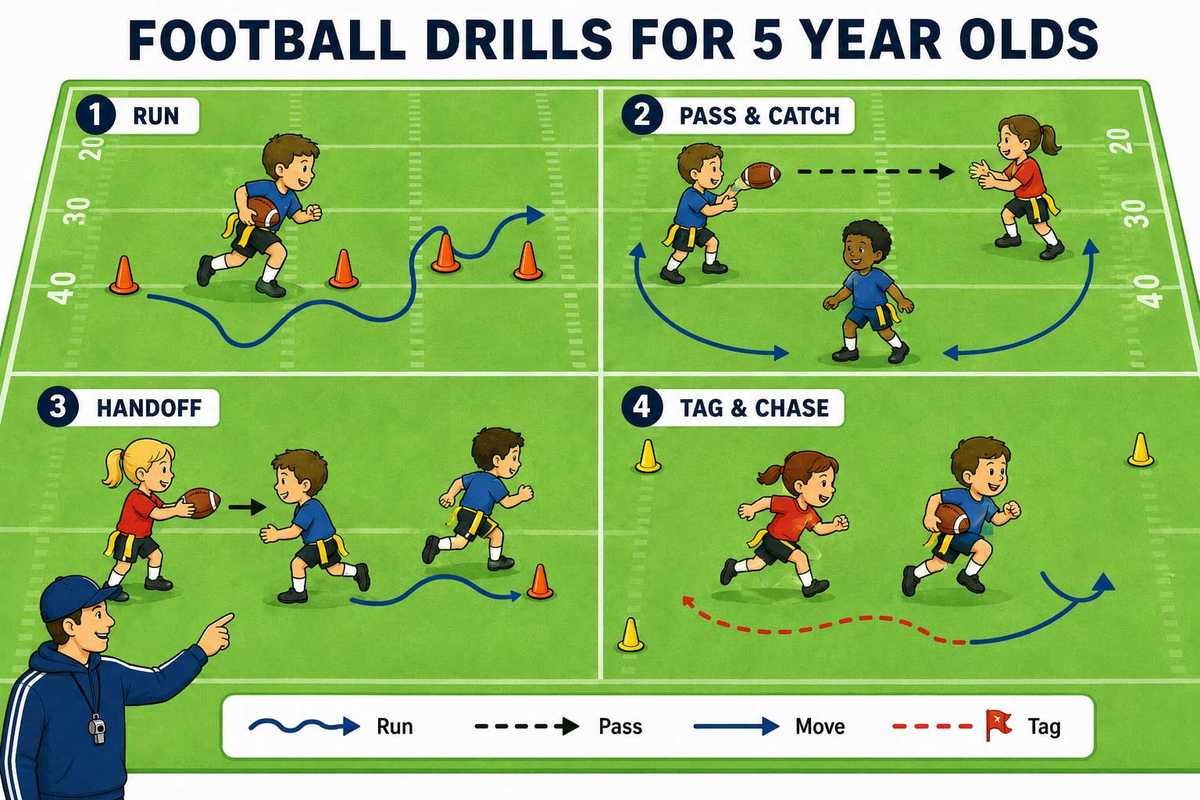
Reactive movement at U5/U6 should be a low-complexity decision layer: move when the coach blows the whistle, turn to the sound, or run to a coloured cone called out. These cues add a decision element without overwhelming coordination demands. Youth coaching documents recommend short, game-like activities that keep engagement high while rehearsing reactive stopping and turning with and without the ball.
Common mistakes in youth agility practice
Two frequent errors reduce value: (1) treating ladder or footwork drills as an end in themselves — for five year olds these can become meaningless busywork unless tied to movement or ball control goals; (2) over-coaching technique details or keeping activities too long. Guidance for 5–6 year olds recommends short activities, variety and play-based formats so children stay active and learn basic control through repetition in context.
How coaches can keep movement work soccer-relevant
Follow these practical rules taken from U5/U6 guidance: keep drills short and fun, use games (tag, gates, cone mazes) that require stopping and turning, and emphasise simple ball actions such as rolling, pulling and stopping. Avoid long static instruction. Observe whether a child can stop or pull the ball reliably in a low-pressure game before adding another layer.
Match transfer and closing interpretation
Practical transfer comes from rehearsing the simple problems young players face in matches: receiving and stopping the ball, changing direction to avoid others, and staying balanced when moving at different speeds. The verified youth-soccer curriculum advice is clear — prioritise general coordination and movement, then layer short ball tasks that demand stopping and playful changes of direction. That sequence is the most defensible route to useful, observable player improvements at age five.
Author: William L.