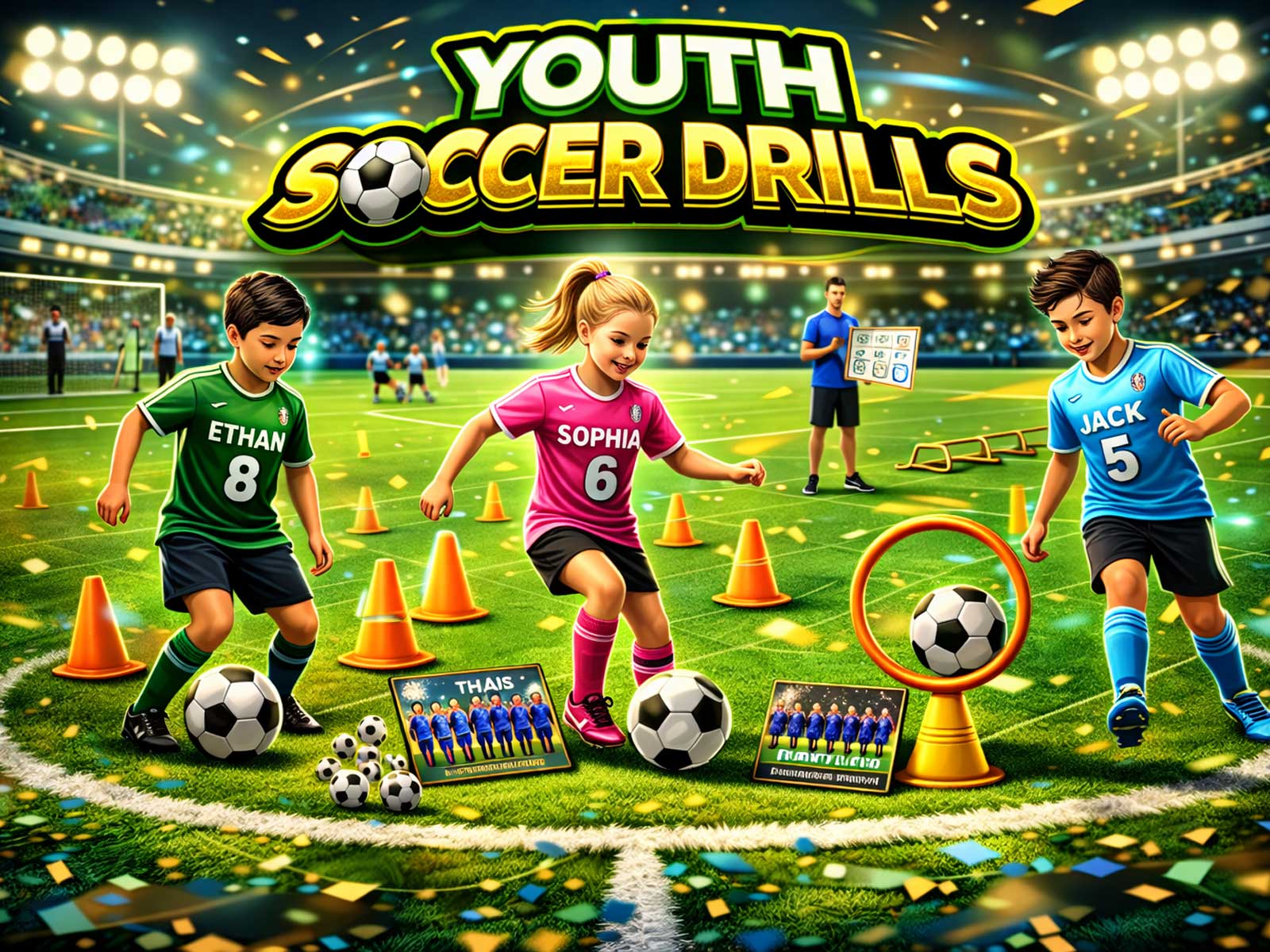
Flag Football Exercises Reframed: Youth Soccer Movement-and-Ball-Mastery Games…
Flag football exercises are built around non-contact running routes, pursuit angles, quick footwork and high-repetition skill practice. Those same constraints and pacing translate directly into youth-soccer movement and ball-mastery games that keep beginners moving, repeat key actions, and develop the movement ABCs — agility, balance, coordination and speed.
Quick answer
Use the structure, grids and activity rules of flag-football drills but substitute dribbling, receiving with the feet and small-sided restart rules. This preserves high activity and trains coordination, footwork and decision-making for U6–U10 players.
What you will learn here
- Which movement qualities flag-football-style drills train and why they matter for young soccer players.
- How to convert pursuit, route-running and flag-removal mechanics into soccer-friendly grids and constraints.
- Practical coaching points to keep activity high and ensure soccer-specific skill transfer.
What speed, agility, and coordination drills really train
Flag-football training resources emphasise agility, movement patterns, pursuit angles and non-contact skill development. In soccer terms those drills are not just arbitrary footwork: they are structured opportunities to practise quick starts, short accelerations, reactive direction changes, body positioning during pursuit and simple sequencing of actions under repeated conditions. For beginners this looks like constant movement in small grids, short running routes, and repeated entries and exits from activity zones — all of which create many brief chances to perform a single motor skill (for example, a short sprint followed by a controlled stop and a foot-surface reception).
Balance, footwork, and movement control
Flag-football drills often require sharp body control while reaching for or evading a flag. Translated to soccer, that becomes control while receiving, changing stance to protect the ball, or stepping to change direction. The coaching focus should be on the quality of weight transfer, stable knee position during deceleration, and quick but deliberate foot placements—not on frantic leg motion. For U6–U10 players, short sequences (2–4 seconds) that force them to balance on one foot, land softly, and immediately re-accelerate build the basic footwork that makes ball skills reliable.
Acceleration, deceleration, and direction change
Flag-football style activities emphasise short bursts and directional change. In soccer-friendly versions keep the same distances and timing: short 5–15m accelerations, a controlled deceleration into a receiving or turning action, then a re-acceleration. Coaching cues should prioritise knee flexion on deceleration, short ground contact times on re-acceleration, and using the arms for balance. These basics are what make a dribble out of a cone or a first touch after a pass functionally useful in play.
Coordination before ball work and with ball work
Player-progression guides and soccer curricula recommend starting with movement coordination drills and quickly pairing them with ball mastery. For example, a short route into a small grid can first be practised as pure movement, then immediately repeated with a ball: sprint into the grid, stop and perform a sole roll or inside-foot reception, then dribble to a restart line. This keeps activity high while ensuring the underlying movement patterns are loaded with ball-specific demands. The goal is not isolated ladder patterns but purposeful coordination that directly supports receiving, shielding and dribbling.
Reactive movement and simple decision layers
Flag-football drills naturally include reaction — react to a whistle, to an unpredicted route, or to a change of role. In youth soccer keep the reactive element simple: one visual or verbal cue that decides whether a player turns left or right, or whether they attack space or protect the ball. This preserves the high repetition of motor patterns while adding the perceptual requirement that makes the movement useful in a match. Small-sided, fast-restart rules used in ball-mastery resources are a practical way of combining reaction with technique.
Age-appropriate movement demands
Validated youth-soccer materials recommend using small grids, short tasks and restart-on-error or restart-on-out-of-bounds rules to keep U6–U10 players active. Flag-football style constraints (clear lanes, short route lengths, and non-contact tagging) scale well: younger players get shorter routes and simpler cues; older beginners can handle multi-step patterns. The emphasis remains on high activity, short technical repetitions and manageable decision-making rather than complex tactical sequences.
How coaches can keep movement work soccer-relevant
Do not use movement drills as standalone fitness or busywork. Adopt the grid sizes, pacing and restart rules common in flag-football resources, but always attach a ball outcome: reception with the feet, a 1v1 dribble to a cone, or a pass off to a teammate after a route. Use coach-led constraints to emphasise the movement intent (e.g., “receive on your back foot and explode away”) and manage repetitions so each child gets frequent touches. This mirrors recommendations from ball-mastery and warm-up curricula that combine speed, agility and technical work in game-like contexts.
Common mistakes in youth agility practice
Two mistakes are frequent. First, turning ladder-style sequences into mindless busyness without clear transfer to receiving, passing or dribbling; second, asking too much decision complexity for very young players and thereby reducing quality repetitions. The defensive correction is simple: every movement pattern should have an immediate ball-related consequence, and decision rules should be binary and brief. That preserves activity while making practice directly useful for soccer.
Closing interpretation
Flag-football exercises provide an excellent template for youth-soccer movement and ball-mastery games: non-contact, route-based constraints deliver many short accelerations, changes of direction and reactive moments. By swapping hand-based outcomes for foot-based outcomes and following age-appropriate grid sizes and restart rules used in soccer curricula, coaches keep beginners active and build the movement ABCs in soccer-specific contexts. The practical aim is simple: maximise relevant repetitions of quality movement that lead immediately into ball actions.
Author: Cynthia D.