How Beginner Soccer Drills for Adults Stay Simple, Repeatable, and…
For adult beginners, the fastest route to comfort with the ball is not complexity but repetition of clear, single-skill actions. Simple drills that isolate receiving, passing weight, and short movement let players make controlled, repeatable improvements before adding speed or opposition.
Summary:
Use partner passing, cone gates and wall-pass progressions. Start stationary, repeat with a clear technical goal, then progress to one-touch and light movement. Keep pressure low until confidence in touch and pass weight is visible.
What a good beginner drill should actually teach
Coaching guidance recommends single-skill, repeatable exercises so learners can focus on mechanics rather than decisions. For adults new to soccer, the essential teaching goals are: clean first touch, consistent pass weight, and comfortable body shape when receiving. Each drill should have one observable success condition (e.g., pass through the gate, controlled first touch into your stride).
Simple drills for control and passing
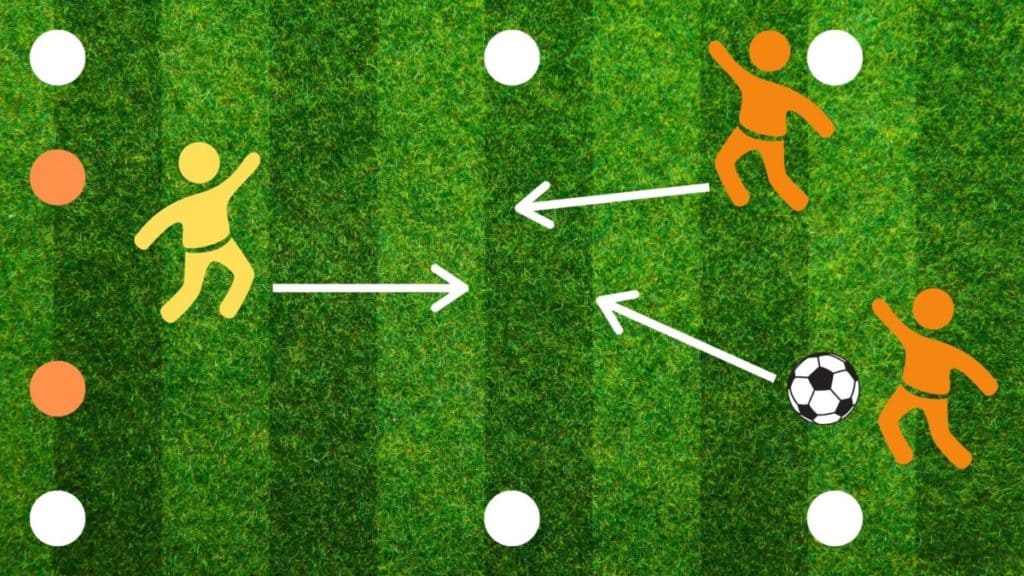
Pair passing is a primary building block: two players pass back and forth over short distances, concentrating on the weight and accuracy of each pass. Passing through small cone gates forces precision without adding pressure from defenders. Wall-pass (give-and-go) progressions and one-touch drills are standard—start with stationary repetitions, then add movement and eventual passive opposition.
How to progress while keeping practice low-pressure
Begin with blocked practice: repeated attempts at the same technical action. Once players can reliably execute the skill, introduce one-touch variations and light movement. Only after technical repetition should you add passive defenders or convert the exercise into a small-sided game. This staged approach follows official starter-kit guidance and helps protect learning by avoiding premature pressure.
Key coaching observation points and common mistakes
Watch for predictable technical errors: poor body orientation when receiving, taking an extra heavy or light first touch, and telegraphed passing technique. Avoid over-coaching during repetitions—give brief cues (foot surface, weight, body angle) and let players repeat. A common mistake is rushing to add opposition before basics are reliable; that reduces repetition and undermines confidence.
Session application and realistic setup
Place short technical blocks early in a session: warm-up, 10–15 minutes of partner passing or gate passing, then progressions to one-touch and wall-pass sequences. Keep equipment minimal—cones and a ball per pair or a wall—and use clear success criteria. Convert to a small-sided game only after the group shows consistent control and passing accuracy.
Why simple repetition builds confidence and match transfer
Repeating a single skill builds automaticity: consistent first touches and pass weights free mental bandwidth so players can later focus on decisions during a match. Progressive additions (one-touch, movement, passive defenders, then active defenders) create a pathway from technical comfort to pressured decision-making. This sequence is supported by coaching frameworks that prioritize technique and clear progressions for beginners.
Author: Cynthia D.