U10s football drills: teaching finishing, movement to goal and simple…
At U10 the finishing lesson is more than kicking hard. Well-designed U10s football drills move from controlled striking practice into small-sided patterns that train decision-making, timing of runs and composure near goal. This article explains what those drills actually train and how to keep technical detail clear while making sessions game-like.
Quick answer
U10s finishing work should combine technical striking practice, shooting on the move and short small-sided progressions (1v1, 2v1, 3v2, conditioned 4v4) to build technique, movement to goal and simple attacking decisions.
What you will learn here
- Why drills must link striking mechanics with movement and decision-making for U10 players.
- Which coaching points to emphasise: body shape, both feet, accuracy over raw power and composure.
- How to structure short age-appropriate progressions from technical work to small-sided finishing games.
What shooting drills really train
Coaching materials for U9–U10 routinely structure finishing work in three linked layers: technical striking, shooting on the move, and game-like small-sided finishing. At this age the aim is not to produce elite power but to build reliable contact, timing and decision-making under progressively realistic pressure. Practical resources and youth federation templates explicitly recommend short activities that emphasise movement into shooting positions and producing repeated, varied opportunities to finish.
Striking mechanics and ball contact
Technical drills isolate the contact: foot placement, ankle firmness, and hitting the ball with the correct surface (laces for driven strikes, instep or inside for placed finishes). Coaching resources for U10s emphasise using both feet and favouring accuracy over power. In practice this means short, focused reps where the coach checks plant-foot distance and toe/ankle position and encourages players to watch the ball through contact. Keep repetitions controlled so technique is not rushed.
Body shape, balance, and composure
Teaching body shape before the shot reduces wildly misdirected attempts. U10 materials highlight leaning over the ball for low drives, non-kicking-arm use for balance, and a consistent follow-through. Composure is trained by small, repeatable scenarios: receiving a pass, a single touch to set, and a composed finish rather than immediate power. Coaches should cue players to scan quickly before receiving and to settle their supporting foot so balance is maintained through contact.
Finishing after a pass, touch, or dribble
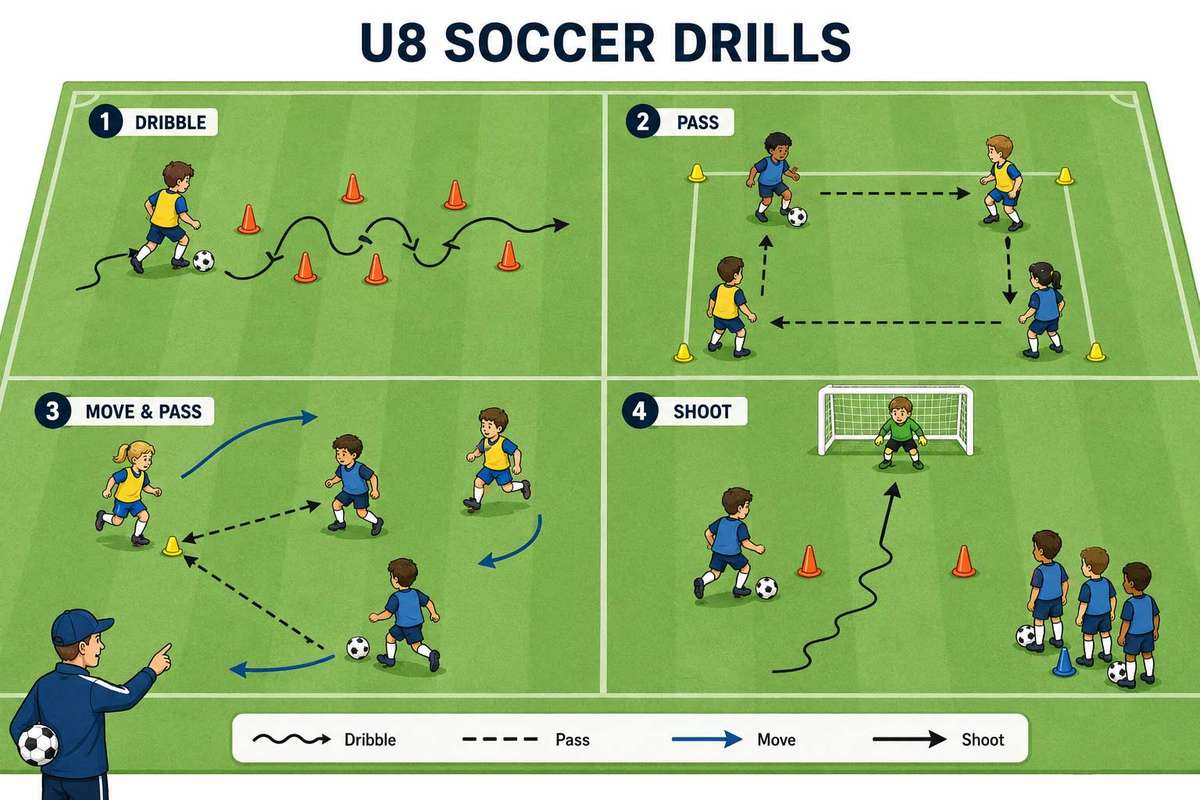
Finishing in youth sessions should reflect the common sequences players face in matches: a pass into feet, a one- or two-touch set-up, or a short dribble into space. Practical U10 progressions start with a coach-fed pass and a controlled finish, then add a receiving touch and finally a short dribble before the shot. This sequence teaches the interplay between the first touch quality, the preparation touch, and the final strike. Coaching materials recommend short drills that explicitly repeat these transitions so players learn the rhythm from reception to finish.
Shot selection for young players
At U10 shot selection must be simplified: encourage placement into corners or low driven finishes when the chance is clear; favour first-time shots only when the angle and body control permit. Coaching templates advise clear cues—if you have time and space, take a set-up touch for accuracy; if unopposed in stride, a first-time finish can be practiced. Reinforce that effective finishing often beats powerful but poorly directed shots.
Repetition, confidence and rhythm in front of goal
Federation and coaching resources recommend short, age-appropriate drill durations (typically 10–20 minutes per activity) with frequent repetitions and small variations. Repetition builds a reliable striking feel; variety prevents mechanical drilling that ignores decision-making. Keep rep volume sufficient for learning but paced so players focus on technique and composure—not rushing. Over time, this balanced repetition supports confidence in match situations.
Common mistakes in youth finishing practice
Common errors are well-documented in youth materials: poor plant-foot positioning, swinging the kicking leg without ankle lock, failing to use the non-kicking arm for balance, and ignoring the quality of the first touch. Coaches often rush players into shooting under unrealistic pressure; instead, progress from isolated technical reps to pressured small-sided formats so errors can be corrected in context. Encourage both-foot work to prevent a dominant-foot-only habit.
How coaches can make finishing drills more useful
Make drills game-like through simple progressions already recommended in practical resources: start with technical striking, add movement and a receiving touch, then introduce 1v1 or 2v1 constraints and finish with small-sided conditioned games (3v2, 4v4 with goals). Use short activity windows, clear coaching points (body shape, accuracy, timing), and reinforce scanning and decision cues. Conditioned games create realistic pressure while preserving focus on the specific finishing behaviour you want to develop.
Match transfer and goalscoring habits
Small-sided finishing games and simple attacking patterns train the habits that transfer to matches: timing runs into shooting lanes, choosing when to shoot or wait for support, and finishing under opposition. National and regional U10 practice templates explicitly use these constrained formats to help young players experience realistic attacking scenarios. Repeated, varied exposure in short sessions builds the decision-making scaffold for future tactical complexity.
Closing interpretation
U10s football drills for finishing should be coherent progressions: technical striking work, shooting on the move, and small-sided attacking patterns. The coaching focus is clear—body shape, ball contact, balance, both-foot competency, simple shot selection and composure. Follow federation-recommended session lengths and progressions to keep practice age-appropriate and to ensure skills learned in drills transfer to match situations.
Author: Eric M.