Football drills U8: Simple, game-based drills that keep beginners engaged with…
For U8 beginners the smart choice is not complexity but structure: short, ball-heavy activities and small-sided games that maximise touches, decisions and fun. This article explains which football drills for U8 players actually keep beginners engaged while they learn basic ball skills and how to coach them simply and effectively.
Quick answer
Choose very short, rotating activities (5–15 minutes each) that keep every child with a ball, use small-sided formats (3v3–4v4) and disguise skill learning with fun constraints and mini-games.
What this guide covers
- Why small-sided, game-based formats work best for U7–U8.
- How to structure short activities to keep attention and increase ball touches.
- Practical drill ideas and coaching rules that fit beginner groups.
What beginner coaching drills really need to do
At U8 the primary aim of any drill is to create repeated, meaningful ball contacts and simple decisions. Verified guidance for grassroots programmes emphasises small-sided, game-based formats (for example 3v3–4v4) because they increase individual touches, force quick choices and keep players involved. Drills should hide the teaching inside play so children practise first touch, dribbling and receiving while feeling like they are playing a game.
Simplicity, clarity, and attention span
Curriculum guidance recommends short activities — typically in the 5–15 minute range — to match attention spans at this age. Keep instructions brief and visual: demonstrate once, use one or two cues, then let the activity run. Use compact areas so players remain close to the action and get more opportunities to touch the ball.
How young players actually learn early skills
Young beginners learn through high repetition and immediate feedback embedded in play. The principle commonly used in grassroots coaching is "every child with a ball": drills like ball mastery, dribbling through gates or partner receive exercises give continuous practice of first-touch habits and control. When children repeatedly succeed at small, concrete tasks their confidence and basic ball comfort grow.
Session organisation and repetition without chaos
Good session flow follows a simple template endorsed by coaching resources: a ball-based warm-up, several short technical/game activities focused on touches and decisions, and a concluding small-sided match to apply skills. Rotate groups quickly, keep numbers low (3v3 or 4v4), and use clear boundaries and simple scoring to avoid disorder while preserving competition.
Fun constraints and keeping beginners engaged
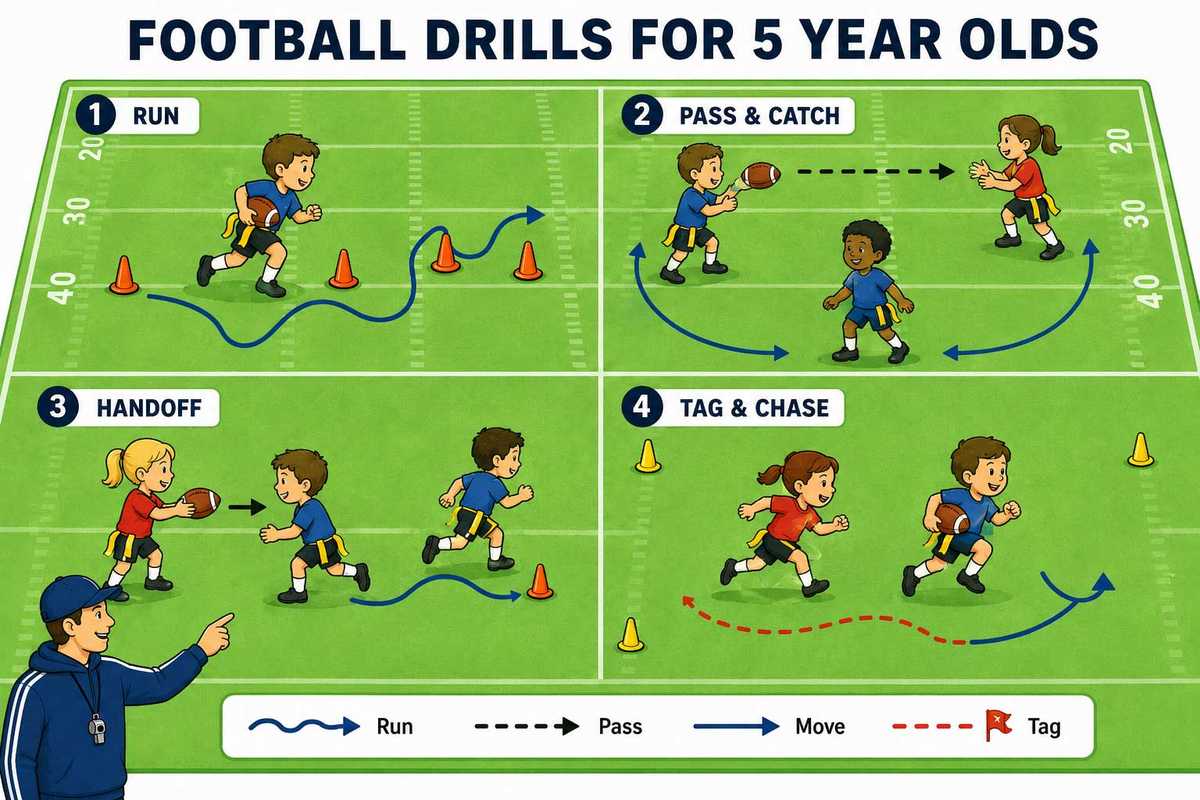
To disguise learning as play, use constraints and game mechanics such as gates to dribble through, relay races, end-zone scoring, mini-goals or "sharks and minnows" variations. Governing-body guidance recommends these forms because they create a purpose for ball control and make repetition enjoyable. The constraint should be easy to explain and immediate to score so attention and motivation stay high.
Correction, demonstration, and coaching language
Minimise long verbal corrections. Demonstrate the desired action quickly, use one short cue (for example "soft first touch" or "look up"), and praise attempts rather than perfect outcomes. Let children fail safely inside the game so they self-correct through repetition. Reserve technical correction for short pauses between activities rather than constant interruption.
Common mistakes new coaches make
New coaches often rely on long lines, excessive explanation, or large-sided games that leave many players inactive. Avoid long drills without the ball, long coach-centred demos, and overcomplicated rules. Also avoid too many simultaneous tasks: at U8 simplicity and single-focus activities produce more useful repetitions and clearer learning.
How to progress a drill without losing the group
Progress by small changes: reduce space to increase pressure, add a passive opponent, or change scoring (e.g., gates count double). Progress only when most players can complete the base task multiple times. Keep progressions quick to explain and easy to reverse; if the group becomes confused, return to the simpler version and try again later in the session.
Foundations that transfer into real play
Small-sided formats and high-touch drills transfer to match situations because they rehearse the same decisions — when to dribble, pass into space, or protect the ball — on a scale young players can handle. The repetition of first-touch and dribbling through constrained targets builds immediate control and confidence, which makes it easier for children to participate in real small-sided matches at the end of practice.
Closing interpretation
For U8 beginners, choose football drills that are short, ball-centred and played in small-sided formats. Use fun constraints and minimal, clear coaching language. Structure sessions as rotating activities that end with a small-sided game so players apply what they practised. These approaches — grounded in grassroots guidance — deliver more touches, clearer decisions and better engagement than long technical lines or too-large games.
Author: Eric M.