Soccer Handball Rule Explained: Intent, Arm Position, and Why Calls Are Debated
The handball law in soccer causes some of the most talked-about decisions in a match. This guide explains the basics of what counts as handball under Law 12, how referees judge intent and body shape, why the attacker-scoring rule matters, and why even with guidance many calls remain controversial.
Quick summary: IFAB defines handball as contact between the ball and the hand/arm below the bottom of the armpit. Deliberate contact or an "unnaturally bigger" body shape can be penalized. Special scoring and sanction rules apply in different match contexts.
Quick access: Definition • How it works • Rules & refereeing
CLEAR DEFINITION
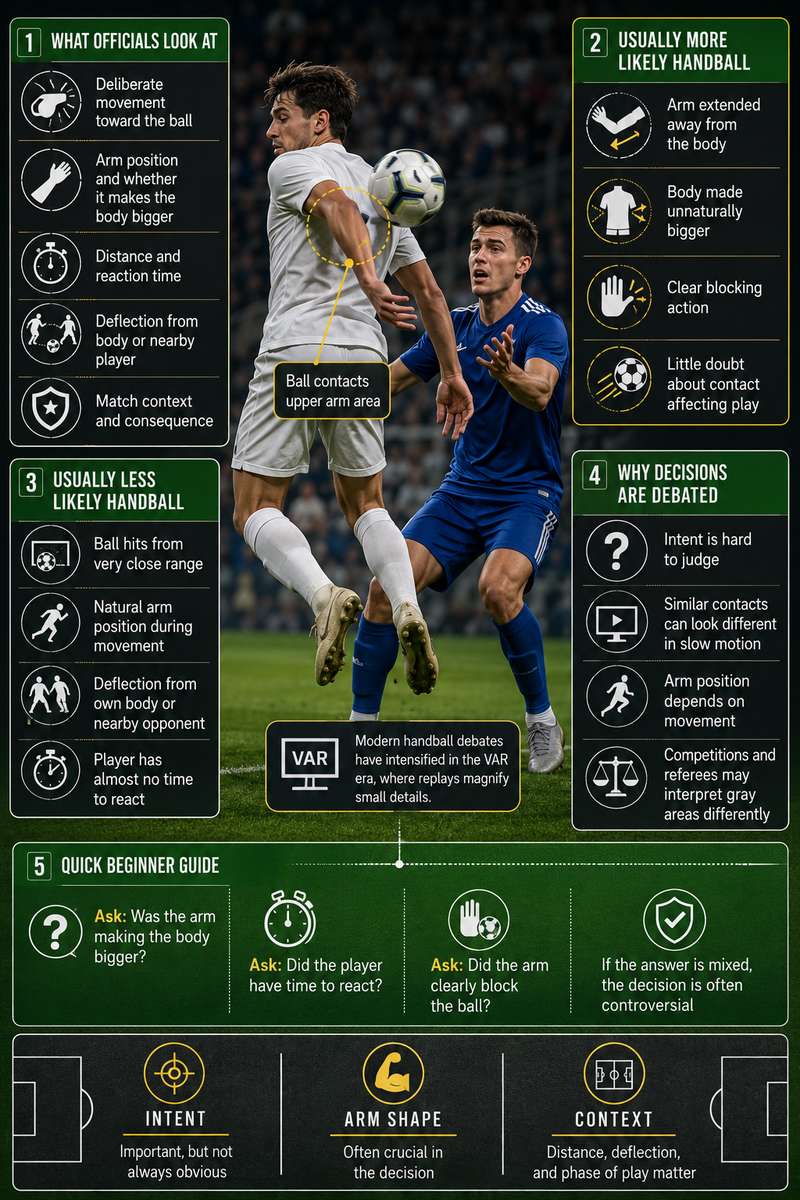
Under the IFAB Laws of the Game (Law 12), handling the ball is contact between the ball and a player’s hand or arm when that part of the body is below the bottom of the armpit. Importantly, the shoulder is not part of the arm for handball purposes. A handball offence can be deliberate contact or result from a player making their body "unnaturally bigger" so the arm position creates a risk of contact.
HOW IT WORKS
There are two core strands officials consider: deliberate action and arm/body shape. Deliberate means the player moved the hand/arm toward the ball. The body-shape criterion looks at whether the arm position is a natural consequence of the player’s movement in that situation. If an arm is away from the body in a way that is not justifiable by the action—thereby making the player "unnaturally bigger"—it can be an offence even without clear intent.
RULES AND REFEREEING
IFAB provides the law text plus clarifications and examples to guide referees. The law also contains specific scoring guidance: if an attacking player scores directly, or immediately after, the ball has touched their hand/arm, the goal is disallowed even if the contact was accidental. Sanctions vary by context: deliberate handball that denies an obvious goal-scoring opportunity can lead to a sending-off, while non-deliberate handball in the penalty area is treated under clarified guidance so that its sanctioning aligns with general foul treatment.
WHY IT MATTERS IN SOCCER
Handball decisions change match outcomes directly: they can stop goals, award penalties, or produce red cards. Because the law applies to both intent and body shape, it affects attacking choices (how players position arms when crossing, shooting, or competing for aerial balls) and defensive behavior (how defenders block crosses or shots without making themselves "unnaturally bigger"). Coaches and players must practice legal body shapes to reduce risk and exploit gray areas responsibly.
COMMON MISUNDERSTANDINGS
Beginners often think any contact with the arm is automatically a foul. The law distinguishes deliberate touches from accidental contact and includes the "unnaturally bigger" test to judge arm position. Another frequent confusion is about the shoulder: IFAB explicitly excludes the shoulder from the arm for handball decisions, so contact with the shoulder alone is not handball under the law.
TRAINING AND YOUTH-SOCCER CONTEXT
In many youth formats coaches teach ball control, body awareness, and how to keep arms close in crowd situations. Because formats and interpretations can vary by competition and age group, youth coaches should emphasize decision-making—when to shield, when to extend an arm for balance, and how to react to deflections—so players build instincts that fit the legal guidance used in older competitions.
SOCCER ART, TEAM CULTURE, AND PLAYER RECOGNITION
Handball moments are dramatic and memorable—sometimes unfairly so—and they often become part of a season’s narrative. For teams creating senior night posters or commemorative wall art, showing decisive match moments (a last-minute penalty awarded or a denied goal) can tell a story about resilience or controversy. Use clear images and captions to capture the moment without implying judgment; the law’s nuance means a single freeze-frame rarely tells the whole story.
WHY HANDBALL CALLS ARE OFTEN DEBATED
IFAB supplies definitions, clarifications, and education materials to improve consistency, and competitions use VAR and review protocols to assist referees. Nevertheless, officials must exercise judgement about intent, body movement, and what is "natural" in that split second. Those subjective assessments, combined with varying camera angles and high stakes, create debate even when referees follow the published guidance.
CLOSING INTERPRETATION
Understanding the handball rule explained by IFAB helps fans, parents, players, and coaches see why decisions are not always clear-cut. The law balances deliberate action and reasonable body shape, applies a strict scoring rule for attackers, and leaves room for referee judgement. That mix of rules and interpretation is why handball remains one of soccer’s most discussed laws—and why teaching good positioning, careful arm use, and visual clarity in team storytelling matters both on and off the pitch.
Author: Eric M.