Offside Trap Soccer Explained: How Defenders Step Up, Why Timing Is Risky, and…
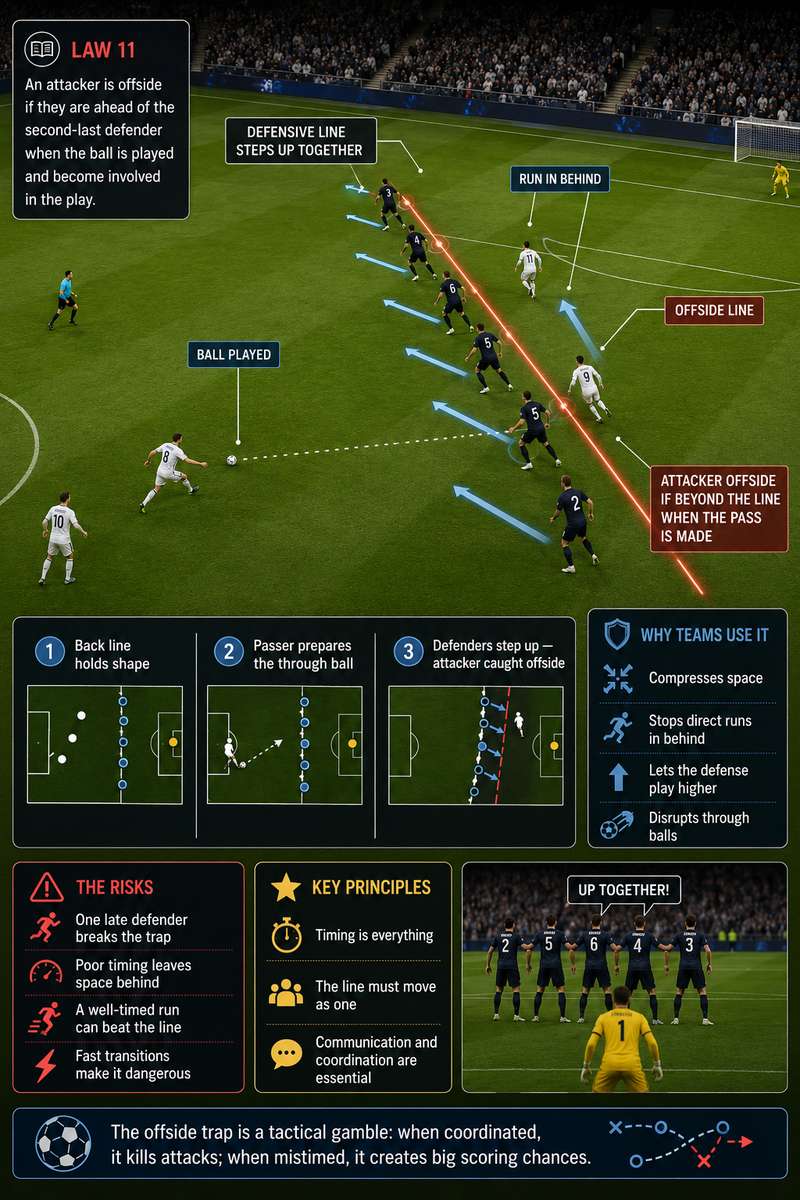
The offside trap is a defensive tactic where the back line steps forward together as an opponent plays a forward pass, aiming to place attackers in an offside position at the moment the ball is played. It’s a high-reward, high-risk tool used by teams that press high and keep a high defensive line; success depends on precise timing, clear communication, and practiced teamwork.
Quick summary: The offside trap requires defenders to step up as a unit when a forward pass is played. It relies on Law 11 being applied by the match officials and is commonly used by teams that press high to compress the pitch.
Quick access: Definition • How it works • Training & youth
CLEAR DEFINITION
The offside trap is a coordinated defensive move in which defenders move forward (step up) as a unit at the instant an opponent plays a forward pass, with the objective of putting attacking players in an offside position under Law 11. When applied correctly, the referee or VAR will judge attackers offside at the moment the ball was played, stopping the attacking chance.
HOW IT WORKS
Execution depends on the defensive line acting together: centre-backs and often fullbacks push up in sync the moment a pass is made. The aim is to create an offside line across the pitch. The crucial moment is the ball being played: the offside decision is made relative to player positions at that instant, not when the attacker receives the ball.
WHY IT MATTERS IN SOCCER
Teams use the trap to compress space, shorten passing lanes, and support a high press. If the trap succeeds, it kills a dangerous attack instantly and keeps play in the opponent’s half. For parents, players and fans, recognizing the trap explains why a promising forward pass is suddenly whistled back for offside rather than ending in a shot or goal.
TIMING RISKS AND FAILURE MODES
Timing is the offside trap’s weak point. If defenders step too early or not together, attackers remain onside or gaps open behind the line. Stepping up also leaves space behind the defense—often only the goalkeeper is deeper—which attackers can exploit with well-timed runs, long balls, or pace. Modern quick passing and refined runs make the trap more situational and riskier than in the past.
RULES AND REFEREEING
The trap’s effect depends on Law 11 (offside). Whether an attacker is penalized is judged at the moment the ball is played. Recent interpretations in the Laws (for example around deliberate play and deflections) and how officials apply offside can change how reliably a trap will be rewarded or punished, so teams must be aware of those subtleties when choosing to use it.
TACTICS AND TEAM SHAPE
Teams that press high and maintain a high defensive line commonly adopt the offside trap as a core tool. It compresses the pitch, helps midfield press succeed, and keeps play in the opponent’s third. The tactic requires a compact shape, clear distances between lines, and defenders who understand when to step and when to hold—often with a vocal leader coordinating the line.
TRAINING AND YOUTH DEVELOPMENT
Coaches teach the trap through repeated drills that emphasize timing, communication, and situational awareness. Practice focuses on synchronized stepping, reading the passer’s body language, and recovery when the trap fails. In many youth formats, coaches use the trap selectively because younger players may lack the experience and pace control needed to avoid leaving large exploitable spaces behind the defense.
TEAM CULTURE, RECOGNITION, AND SOCCER ART
Using the offside trap successfully signals defensive cohesion and discipline—qualities teams often celebrate in season posters, senior night art, or player recognition pieces. A custom soccer poster that highlights a defensive back line or a single defender known for reading the game can capture that collective identity. Such visual pieces work well for coach gifts, team awards, or room decor that honors teamwork and tactical intelligence.
READER VIEWING GUIDE
On TV or from the sideline, look for the defensive line suddenly moving up as the ball is played, and watch the moment the pass is released: that snapshot determines offside. Notice communication—defenders pointing or shouting—and whether the goalkeeper is positioned high (a sign of a high line). When the trap fails, watch the space behind the line and the speed of the attackers’ runs; those are the telltale vulnerabilities.
CLOSING INTERPRETATION
The offside trap blends law, timing, and teamwork. It remains a powerful tactical choice for high-pressing teams but is inherently risky because a single mistimed step hands the opponent a clear path behind the defense. Understanding how it works helps parents, players, and fans read matches more clearly and appreciate the discipline behind defensive play—a theme that also translates into meaningful team gifts and custom wall art celebrating collective effort.
Author: William L.