Why small-sided U10 football drills often teach more than isolated lines and…
For U10 coaches deciding between repeated line drills and small-sided games (SSGs), the choice is not just about variety — it’s about what players actually practise when they touch the ball. Small-sided U10 football drills put children in match-like problems repeatedly: more touches, more decisions, and clearer links between practice and game behaviour.
Quick answer
Research and governing-body guidance show SSGs raise involvement (more ball touches), improve technical and tactical outcomes, and allow coaches to shape learning through simple constraints—benefits that isolated line drills struggle to match for U10 players.
What you will learn here
- What small-sided games train in concrete U10 terms.
- Which player behaviours and decision moments SSGs reproduce better than lines.
- How coaches can manipulate SSG constraints to focus learning.
What small-sided games really train
Small-sided games (3v3, 4v4, 5v5 and similar formats recommended for pre-adolescents) combine technical execution, tactical choice and physical activity into single, continuous tasks. Empirical reviews show SSGs increase the number of ball touches and moments of involvement per player compared with large-sided matches or isolated drill formats. For U10s this means more repetitions of passing, receiving and dribbling under realistic pressure, and more opportunities to practise simple tactical problems such as creating width, supporting a player on the ball or choosing when to pass versus carry.
Space, spacing, and player involvement
SSGs change the relationship between space and behaviour. Smaller teams on reduced pitches create repeated, readable spacing problems: where to position to receive, when to move to support, and how to open channels for progression. Studies that focus on U10 and adjacent ages report that these formats increase exploratory behaviour and tactical creativity because children repeatedly experience the same spatial dilemmas and can test different solutions within a safe, game-like context.
Decision-making under simple pressure
Line drills isolate a technical action; SSGs add a decision layer. Research shows that SSGs allow coaches to deliver technical repetitions while simultaneously forcing choices: pass or dribble, turn or face play, press or delay. For U10 players, these decisions are low-complexity but frequent, which supports the development of fast, experience-based reading of situations. The mechanism is straightforward: more touches in contested, time-limited scenarios create direct cause–effect learning — players see the result of a decision and can try alternatives immediately.
Constraints, rules, and learning design
Validated studies note that manipulating SSG constraints (player numbers, pitch size, scoring rules) reliably adjusts the tactical and physical demands on players. Coaches can make small changes to emphasise particular outcomes: reducing the pitch forces quicker decisions and tighter passing, adding target players encourages progression and support angles, and limiting touches can sharpen first touch and scanning. These are defensible, evidence-backed levers for U10 coaching that keep practice contextual while making learning aims explicit.
Common mistakes in youth small-sided practice
Even though SSGs are endorsed by major bodies, they lose value when poorly managed. Common errors include: using overly large teams that dilute touches, failing to set clear constraints so the task becomes vague, over-coaching technical points mid-play (which breaks flow), and not varying pitch size to suit the objective. Research indicates optimal learning comes when SSGs are simple, constrained to the learning aim, and kept small enough to guarantee repeated involvement for each child.
How coaches can shape the game without killing it
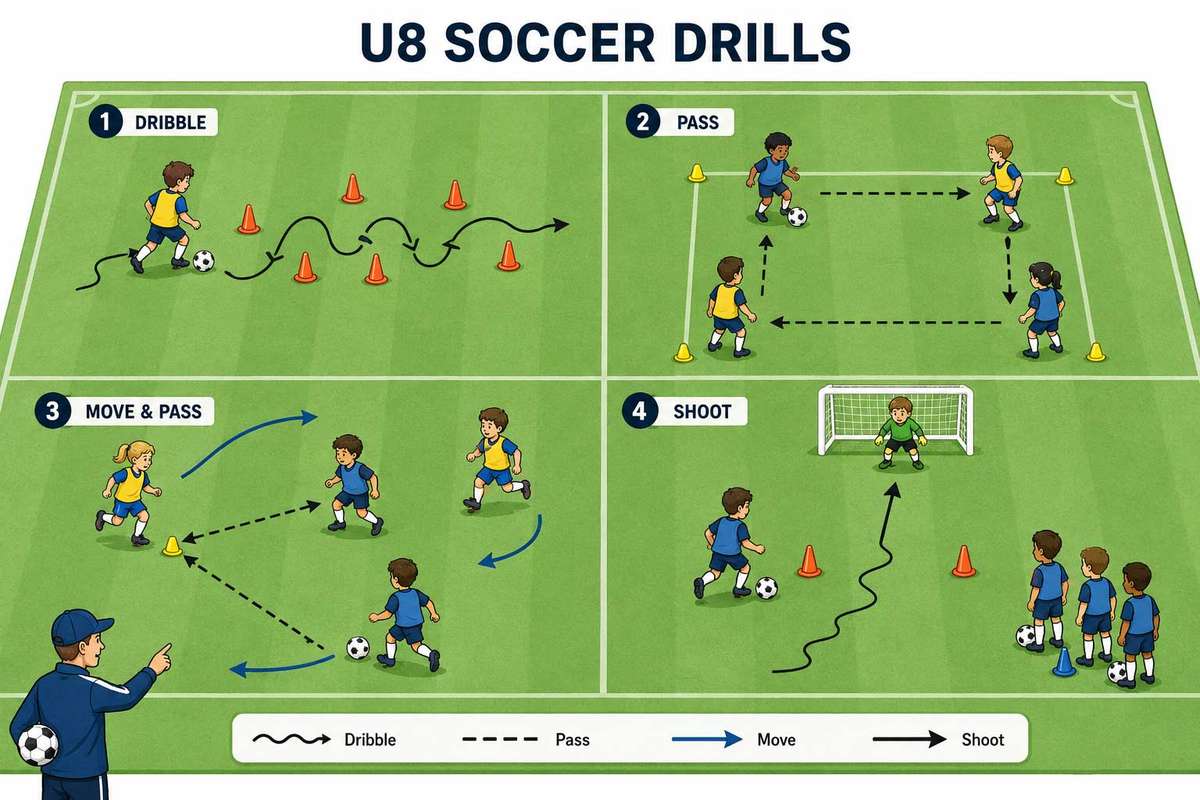
Design SSGs with a single, observable coaching focus. Choose one variable to manipulate (e.g., 4v4 on a narrow pitch to emphasise passing angles) and give a short, specific instruction: "create a supporting line within two passes." Observe emergent behaviours: who scans before receiving, who supports too late, who monopolises the ball. Use brief interventions between plays rather than constant interruption. Research supports this coach-light, constraint-based approach as effective for producing technical and tactical gains in U10 players.
Match transfer and tactical understanding
Because SSGs present the same perceptual cues found in matches—opponent proximity, limited space, and teammates’ movement—they promote transfer to actual games. Systematic reviews and meta-analyses report improvements in tactical behaviours and technical execution following SSG interventions. For U10 teams, regular exposure to small-sided formats helps children recognise basic match situations and rehearse appropriate solutions: retaining possession under pressure, finding simple progression routes, and reacting quickly during transitions.
Closing interpretation
For U10 coaches the evidence is clear: small-sided football drills are not just a fun alternative to line work; they are a research-backed way to increase touches, decision opportunities and tactical learning in realistic contexts. That said, SSGs require purposeful constraint design and attentive coaching to avoid common pitfalls. When used deliberately — with small teams, clear aims and measured interventions — SSGs deliver the kinds of repeated, decision-rich practice young players need to bridge training and match behaviour.
Author: William L.